
As a human being and as a psychiatrist who has lived through countless emotionally demanding days, I have come to recognize a particular kind of pain. It is the pain that shows up silently, usually when we least have the time or patience for it. The kind that starts as a whisper behind the eyes before tightening like an invisible band around the forehead.
Yes, you got that! I am talking about Tension and Stress Headaches-a condition I don’t just diagnose in others, but have navigated myself during late-night calls, 36-hour duties, hectic ward rounds, research deadlines, and the juggling act of wearing far too many hats at a time.
My young enthusiasts, if you are reading this, chances are you have experienced that same familiar ache-the one that arrives precisely when your responsibilities peak. And if you are anything like my patients or me, you have probably tried to push through the pain, hoping it will vanish if you “just wind up one more task”.
But headaches don’t negotiate. They only amplify.
In my previous work, “5 Early Signs You Are Developing Tension And Stress Headaches”, we explored how our body sends warning signals long before the pain becomes unbearable. Today, consider this a continuation of that conversation between you and I-more like two individuals sitting across from each other, figuring out ways to soothe a mind and body that’s simply overwhelmed.
So allow me to walk you through some quick, practical, and genuinely effective home remedies I recommend to my patients, my friends, and even myself when life becomes too heavy for the head to carry alone.
Why Does Your Head Hurt? The Science Behind Tension And Stress Headaches.
Before we dive into the remedies, let me take you behind the scenes-into the fascinating neurobiology of why Tension and Stress Headaches occur in the first place.
As someone who has spent years studying the brain, and many nights experiencing its reactions firsthand have learned that a Tension and Stress Headache. It’s a full-body stress response written in neurological ink.
When you are super saturated, under pressure, emotionally drained, or even just staring at screens longer than your nervous system approves, your body activates a chain reaction:
1. Your Stress Hormones Surge.
Cortisol and Adrenaline rush through your bloodstream. Their main job is to help you survive the fight or flight mode. However, when they are elevated for a long time, they create internal chaos.
2. Your Neck and Scalp Muscles Tighten.
This is the body’s ancient defence mechanism. When your brain perceives stress, it sends signals to tighten specific muscle groups. The neck, temples, jaw, and forehead stiffen-forming a classic “helmet of tension”.
3. Your Pain Pathways Activate.
The tightened muscles compress the surrounding nerves and blood vessels. This triggers the trigeminal nerve, the brain’s main pain communicator.
Once activated, it sends one message loud and clear: “You’re not okay. Slow down.”
4. Your Brain’s Pain Filter Weakens.
Normally, the brain can dampen pain signals. But chronic stress reduces serotonin and other stabilizing chemicals-lowering your pain threshold. This is why a minor ache becomes a full-blown headache under stress.
5. Your Mind Amplifies The Pain.
Psychology and neurology dance together.
Your fears, emotions, thoughts, and even your personality style can influence the intensity of a headache. (I see this every day in my practice; patients who “power through” are often the ones who crash hardest).
“Your headache is not a failure of your body—it is a conversation starter.”
Your brain is asking for rest.
Your muscles are asking for softness.
Your nervous system is asking for safety.
Once you understand what’s actually happening inside you, the remedies don’t just work better-you begin to use them with intention, not desperation.
Without further ado, let’s dive into some home remedies to cure Tension and Stress Headaches.
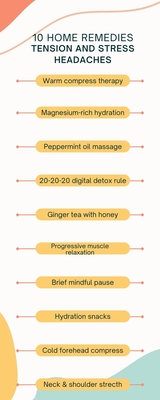
1. Warm Compress Therapy.
I often describe heat as “the kindness your muscles didn’t know they needed”. Place a warm compress on the back of your neck or over your forehead for 10-15 minutes. The gentle warmth relaxes tight muscles and improves blood circulation, giving your head a chance to breathe again.
Pair this maneuver with slow shoulder rolls for an added release.
2. Magnesium-Rich Hydration.
A surprising number of patients are dehydrated without realizing it. Dehydration makes the brain contract slightly, triggering headache pathways.
Drink a tall glass of water mixed with a pinch of magnesium powder (if medically safe for you). Magnesium is known to relax muscle fibers and reduce nerve excitability.
I call it the “neuro-calming mineral,” and it helps more than most people expect.
3. Peppermint Oil Massage.
Peppermint oil remains one of my all-time favorite natural remedies. Applying diluted peppermint essential oil to your temple region and forehead creates a cooling effect that reduces muscle tension.
Research even shows it works similarly to over-the-counter analgesics in some cases.
This is one of the few remedies I use even during call nights because it works quickly and leaves the mind refreshed.
4. The 20-20-20 Digital Detox Rule.
Excessive screen usage contributes heavily to Tension and Stress Headaches, especially for people who work for long hours.
Every 20 minutes, look at something 20 feet away for 20 seconds.
It seems small, but this micro-break reduces eye strain, unclenches the forehead, and prevents the head from “locking” into stressful patterns.
5. Ginger Tea With Honey.
Ginger is nature’s anti-inflammatory miracle.
Boil fresh ginger in water, add a teaspoon of honey, and sip slowly.
This does more than ease headaches. It quickly calms down the nervous system and soothes emotional turbulence.
One of my patients once said, “I feel like ginger tea hugs my brain,” and I couldn’t agree more.
For those who want to explore more herbal approaches, you can read an excellent external piece on herbal headache relief at Healthline.
6. Progressive Muscle Relaxation.
When the mind is overwhelmed, the body becomes its spokesperson.
Lie down, and close your eyes. Tense every muscle group for 10 seconds and then release.
Start from your feet and move upwards.
Within minutes, your nervous system shifts from “fight or flight” to “rest and digest”, relieving Tension and Stress Headaches with surprising efficiency.
7. A Brief Mindfulness Pause.
Mindfulness doesn’t require sitting cross-legged on a mat for an hour.
Sometimes, it is simply allowing yourself to breathe.
Place your hand on your chest, inhale for five seconds, hold for 3 seconds, and exhale for 5 seconds.
Repeat this exercise five times.
This breathing pattern lowers sympathetic activity-calming the mind and dispersing head pressure.
You can also explore a beginner-friendly guide to mindfulness at Mindful.org.
8. Hydration Snacks: Cucumbers, Watermelon, & Oranges.
These delicious fruits don’t just hydrate-they deliver electrolytes that prevent headaches triggered by fluid imbalance.
On my busy hospital days, I often keep sliced cucumbers and oranges in my bag. I also add a few cucumbers to my water bottle. Small choices like these prevent the “afternoon crash” that often leads to a headache spiral.
9. Cold Forehead Compress.
While warm compresses relax, cold compresses numb. If your headache is pulsating or triggered by heat exhaustion, place an ice pack on your forehead or temples for 10-15 minutes. It constricts dilated blood vessels and provides fast relief.
10. A Quick Neck & Shoulder Stretch.
If I were to prescribe a single non-medical remedy, it would be stretching. The majority of Tension and Stress Headaches originate from neck and trapezius tightness.
Try this:
- Drop your right ear to your right shoulder.
- Hold for 20 seconds.
- Repeat on the left side.
- Gently rotate your neck in slow 360-degree circles.
This simple routine dissolves the pressure that feeds headache pathways.
A Warm Takehome Message
Healing from Tension and Stress Headaches is less about eliminating pain and more about learning to honor your body’s signals with compassion. Every remedy you practice is an act of reclaiming your peace.
Remember, your headache is not an inconvenience; it’s a soft reminder that you deserve care, gentleness, and space to breathe. At YouthTableTalk, we welcome you to be kind to yourself, listen to your body’s whispers, and allow rest to become part of your healing rhythm.
FAQs
1. Can Tension and Stress Headaches happen even when I don’t feel stressed?
Yes, your mind may not feel stressed, but your body keeps its own score. Sometimes stress sinks into the subconscious, and the body expresses what the mind suppresses.
2. Why do my headaches get worse in the evening?
Throughout the day, micro-stressors accumulate. By evening, your nervous system reaches its saturation point.
3. Can certain personality traits make me more prone to Tension and Stress Headaches?
Most certainly. Individuals who are perfectionists, overly responsible, empathetic, or sensitive to emotional environments often carry more muscular and mental tension.
4. Do Tension and Stress Headaches affect memory or focus?
Yes. When your brain directs energy towards pain processing, cognitive bandwidth decreases. It’s called the “mental fog”. These headaches can interfere with decision-making, concentration, and emotional regulation.
5. Why does rubbing my temples or scalp help so much?
It stimulates sensory nerves, increases local blood flow, and interrupts pain signals heading toward the brain.
It also activates your parasympathetic nervous system—the “rest and digest” mode—reducing physical and emotional tension.