
My dear readers,
After writing “14 Ways To Rebuild Love and Self After An Emotional Burnout”, I received a message from a reader who said, “Okay, I feel rebuilt, but now what? How do I maintain it every single day, especially when life keeps draining me?”
As a psychiatrist and as someone who has personally walked through emotional collapse, identity fatigue, and the long journey back into self-connection, I understood the depth of that question. Rebuilding is one thing; sustaining is another.
That’s why I created this sequel to guide you about some rituals that you can easily practice daily to foster Love and Self, even when your days feel chaotic, overstimulating, or emotionally unpredictable. These rituals aren’t just theoretical. I have practiced them myself, recommended them to countless patients, and refined them through lived experience.
Each ritual is simple yet deeply transformative. Think of them as small anchors-delicate habits that keep you grounded in inner clarity, presence, and safety.
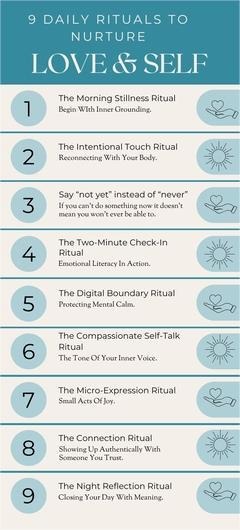
1. The Morning Stillness Ritual: Begin With Inner Grounding.
When my own nervous system feels frayed and foggy, I turn to this ritual. I sit with myself for five to ten minutes every morning-no phone, no social media, no expectations.
I inhale deeply.
And I ask: “What does my mind need today? What does my heart desire today? And what does my soul seek today?
This moment of stillness resets my emotional compass. Research consistently shows that morning mindfulness reduces stress hormones and improves emotional regulation. But beyond the science, there is a soft magic in beginning your day with yourself.
There is a quote I hold dear to my heart:
“When I sit with myself, I return to myself”.
This ritual nurtures Love and Self by creating a sacred pause before the world intrudes.
2. The Intentional Touch Ritual: Reconnecting With Your Body.
During burnout, people disconnect from their bodies without realizing it. I did too. The body becomes a vessel of tasks, not tenderness.
So, I started practicing intentional touch: moisturizing my hands slowly, placing my hands over my chest whenever I felt overwhelmed, and gently massaging my temples during stressful on-call nights.
It activates the body’s soothing system and increases the hormone of bonding, i.e, Oxytocin.
Tell yourself:
“This body has carried me through storms. It deserves gratitude, not neglect.”
This small act keeps Love and Self in physical harmony and synchrony.
3. The One-Thing-At-A-Time Ritual: Radical Presence In A Distracted World.
Most of us live in cognitive overload-multitasking, shifting attention, jumping between tabs in our minds. I remind myself: Presence is medicine.
Every day, choose one activity and do it with complete presence:
- Drinking a cup of coffee.
- Folding my clothes and organizing them in my closet.
- Walking between wards.
- Listening to a loved one.
- Daily journaling before dosing off.
No rushing. No background noise. No “meanwhile..”
Presence sharpens the mind, softens the heart, and prevents emotional burnout from silently accumulating.
I love this saying, “When I am fully here, life feels less heavy”.
4. The Two-Minute Check-In Ritual: Emotional Literacy In Action.
As a psychiatrist in training, I believe emotional literacy is the foundation of psychological resilience. Every day, preferably mid-day, I take a pause and ask myself three essential questions:
- How do I feel right now?
- Where is this feeling sitting in my body right now?
- What do I need at this moment?
Believe it or not, these little check-ins serve as micro therapy sessions with yourself. They prevent emotional overwhelm from leaking into your relationships, decisions, and sense of self-worth.
This ritual strengthens Love and Self by connecting your inner and outer worlds.
5. The Digital Boundary Ritual: Protecting Mental Calm.
Digital overstimulation is one of the biggest modern causes of emotional corrosion. I personally noticed that my anxiety was worse on days when I kept checking messages, emails, and notifications.
So now I have firmly implemented these boundaries:
- No random scrolling during moments of exhaustion.
- No emotionally charged conversations after 10 pm.
- No electronic gadget usage for 30 minutes after waking up.
You can also explore resources on digital well-being, like this thoughtful piece on “The Psychology of Attention”.
By protecting your mental space, you nourish both Love and Self with clarity and peace.
6. The Compassionate Self-Talk Ritual: The Tone Of Your Inner Voice.
We underestimate how destructive our inner dialogue can be. I spent years unknowingly speaking to myself in a tone I would never use with a patient or a loved one.
Now I consciously practice compassionate self-talk:
- It’s okay to take a pause and rest.
- I am learning from my experiences one day at a time.
- I am worthy even when I am tired.
- I am allowed to make mistakes.
- Every day, I am becoming a better version of myself.
Research demonstrates that self-compassion improves resilience, emotional flexibility, and interpersonal functioning.
Think of it as re-parenting-giving your mind the gentleness it always deserved.
I really admire a quote: “The way I speak to myself determines how deeply I can love myself.”
7. The Micro-Expression Ritual: Small Acts Of Joy.
This ritual saved me from some of my hardest rotations. Instead of waiting for big joys, I started intentionally creating small ones.
I would:
- Open my window and breathe fresh air for 10 seconds now and then.
- Enjoy a piece of my favorite chocolate.
- Send a message of gratitude to someone.
- Read two lines of a self-help book or listen to a short podcast.
- Step into the sunlight during a break.
These tiny joys reset the emotional thermostat. They teach the brain that safety and delight exist even during difficult seasons.
8. The Connection Ritual: Showing Up Authentically With Someone You Trust.
Connection is not a luxury, and so never take it for granted. It is nourishing for your soul. Once a day, I make an intentional effort to connect with my loved ones authentically. For instance:
- A short call.
- A heartfelt message.
- A 2-minute voice note.
- A deep talk with my partner or best friend.
Even as a psychiatrist who witnesses emotional pain daily, I realized: We heal through relationships.
We are wired for connections, and there is no way we can thrive without them.
You can explore more about relational well-being through this beautifully written guide on human bonding on Medical News Today.
Let someone witness you. Let yourself be seen.
That shared humanity nurtures Love and Self most profoundly.
9. The Night Reflection Ritual: Closing Your Day With Meaning.
This one is my favorite ritual-and the one that has transformed my relationship with myself-is my nightly reflection practice.
Every night, I sit with myself and pen down three things:
- One moment I am grateful for during the day.
- One thing I learned about myself today.
- One intention for tomorrow.
This ritual prevents emotional stagnation. It brings closure to your day instead of letting emotions simmer unprocessed.
Reflection gives shape to your inner world and meaning to your journey.
This quote makes perfect sense to me: “When I reflect, I reconnect”.
The Heart Of These Rituals: A Life Where Love and Self Co-Exist Gently.
These nine rituals are not tasks; they are invitations. Invitations to return to yourself, rebuild inner safety, and cultivate a life where your emotional, physical, and spiritual well-being coexist peacefully.
Each day, I remind myself:
“Healing is not a destination. It is a daily relationship with myself.”
And if you ever feel lost, or stuck, or quietly aching for support, you can always come home to us at YouthTableTalk, where healing, compassion, and shared humanity are honored.
My Personal Reflection
In learning to nurture Love and Self, I have realized that healing is never a grand milestone; it is a quiet practice, repeated daily, almost tenderly. As a psychiatrist, I have spent years guiding others through their storms, yet my own heart needed the same gentleness I often prescribed.
These rituals taught me that love is not something I earn; it’s something I return to. And the self is not a project to fix; it’s a home to inhabit. Each small act-breathing, pausing, listening-became a bridge back to myself. Harmony was never lost. It simply waited for me to slow down enough to feel it.
FAQs
1. Can I practice all nine rituals if I have a very busy schedule?
Yes. You can. Most of them, if not all, as these rituals are intentionally designed to be short, gentle, and flexible. Even practicing three to five of these consistently can create profound emotional changes.
2. What if I skip a day or fall out of routine?
That’s completely normal. Healing isn’t linear. The goal is not perfection-it’s return. You can restart any time without guilt.
3. Do these rituals replace therapy?
No. They complement therapy, but they are not a substitute for professional mental health care. If you are struggling with persistent emotional difficulties, anxiety, depression, or anything similar, seeking help is an act of strength.
4. How long does it take before I feel a difference?
Usually, it takes around 7-14 days for anybody to begin to feel the difference if they are persistent in practicing the rituals.
5. Can these rituals improve relationships as well?
Absolutely. When you nurture Love and Self, the compassion, presence, and clarity spill over into your relationships naturally.
References
- Neff, K. (2003). Self-Compassion: An Alternative Conceptualization of a Healthy Attitude Toward Oneself.
- Siegel, D. (2012). The Mindful Brain: Reflection and Attunement in the Cultivation of Well-Being.
- Gilbert, P. (2010). The Compassionate Mind.
- American Psychological Association – Mindfulness and Psychological Well-Being.
- Porges, S. (2011). The Polyvagal Theory.

Dr. Talia Siddiq is a resident psychiatrist in training at Dr. Ruth K.M. Pfau Civil Hospital Karachi, deeply passionate about understanding the human mind and helping people find healing. Beyond her clinical work, she is also a writer who believes that mental health conversations should be easy, relatable, and stigma-free.
She started writing in 2020, turning her reflections and experiences into articles that speak to the struggles many young people silently face—whether it’s self-harm, addictions, relationships, or simply finding direction in life. Over time, her writing has expanded into areas like career guidance and financial independence, because she strongly believes that resilience isn’t just about surviving emotionally—it’s about building a meaningful, balanced life.
For Talia, YouthTableTalk is more than a blog. It’s a safe corner on the internet where young people can pause, reflect, and feel understood. Her goal is not to lecture but to have a conversation—just like a friend who listens, shares, and gently guides you toward growth.
When she isn’t studying psychiatry or writing, you’ll often find her reading, exploring self-growth books, or cooking something new for her family. She brings the same curiosity and compassion to her personal life that she does to her work: always seeking better ways to connect, learn, and inspire.
Through YouthTableTalk, she hopes to remind every reader of one simple truth: you’re not alone, and your story matters.