
“Sometimes, the pain in your head is not a medical mystery—it is a lifestyle confession.”
Why Headaches Become A Daily Companion?
Believe it or not, I have spent years listening to people describe pain that doesn’t show up clearly on scans or routine blood work. Among the most common- and the most misunderstood-complaints I hear is the constant frustration of recurring Tension and Stress Headaches. Patients often arrive apologetic, as if headaches that come and go are not “serious enough” to bring to medical attention.
Yet I have discovered, both clinically as well as personally, that these headaches are rarely random.
There was a phase in my own life when I found myself ending most days with a familiar tightness around my temples. It was around the time when I was appearing for my Residency Induction Exam, known as FCPS-I. At first, it wasn’t dramatic enough to stop me from studying and working hard all day long, but it was persistent enough to dull my focus, reduce my attention span, and erode my patience in performing complex tasks. Like many of my patients, I initially blamed stress in a vague, resigned way-until I realized that stress does not exist in isolation itself through habits.
Previously, I guided you through “10 Quick Home Remedies For Tension And Stress Headaches.” While remedies help manage pain once it appears, habits explain why it keeps returning. If you have tried oils, stretches, hydration, or rest and are still trapped in a cycle of headaches, it may be time to look more closely at the rhythm of your everyday life.
Why Daily Habits Matter In Tension And Stress Headaches?
From a doctor and psychiatrist’s perspective, Tension and Stress Headaches are not merely musculoskeletal issues like most people tend to think and subsequently ignore. They are a result of a complex interaction between the brain, muscles, hormones, and emotional regulation systems.
Repeated daily behaviors can:
- Dysregulate the balance of cortisol and adrenaline in the body.
- Maintain chronic muscle contraction.
- Reduce the body’s ability to return to a relaxed baseline.
- Lower the brain’s pain threshold.
What makes habits powerful is that they are often unconscious. We do not choose them intentionally, yet they shape our physiology continuously.
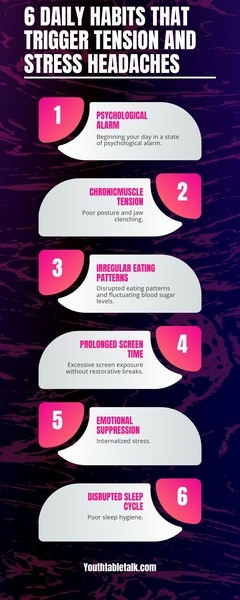
So, let me take you through 6 Daily Habits That Trigger Tension And Stress Headaches.
1. Beginning The Day In A State Of Psychological Alarm.
“The way you wake up teaches your nervous system what to expect from life.”
I can bet that most teenagers and young adults develop Tension and Stress Headaches because they start their day in a rush. Alarm clocks are snoozed aggressively, phones are checked first thing when eyes open, and the mind begins racing before the body has even adjusted to wakefulness.
Neurobiologically, this sudden mental activation stimulates the sympathetic nervous system, which keeps you on edge throughout the day. Stress hormones surge as they do in any “fight” or “flight” situation. Muscles tighten reflexively, especially in the neck, shoulders, and jaw, and the body enters a hyperarousal state far earlier than necessary.
With the passage of time, this repeated morning alarm response trains the nervous system to remain in fight mode throughout the day.
By evening, the accumulated muscle tension often presents as a dull, squeezing headache.
As a hyperfunctioning and overambitious doctor who has lived this pattern, I can say this with confidence: productivity achieved through urgency often comes at the cost of physical comfort.
2. Chronic Muscle Tension From Poor Posture And Jaw Clenching.
Many people associate poor posture with back pain, but very few can figure out how directly it contributes to Tension and Stress Headaches. Hours spent leaning towards laptop screens, hunching shoulders, or holding the head forward strain the cervical spine and surrounding muscles.
Clinically speaking, this posture overloads the trapezius, sternocleidomastoid, and suboccipital muscles. All of these structures are involved in Tension and Stress Headaches. Add unconscious jaw clenching, which is extremely common in emotional suppression, or deep focus, and the head becomes a site of continuous muscular stress.
What makes this habit particularly harmful is that it often goes united. Patients genuinely believe they are relaxed because they are mentally calm, while their muscles remain in a state of guarded contraction.
I often discuss this mind–body disconnect in my mental health writing, including on YouthTableTalk, where psychological insight meets everyday physiology.
3. Irregular Eating Patterns And Blood Sugar Fluctuations.
Another underestimated contributor to Tension and Stress Headaches is inconsistent nourishment, poor diet, and junk food. Skipping meals, delaying food intake, or relying heavily on caffeine disrupts blood glucose stability.
From a psychiatrist’s standpoint, low blood sugar mimics and amplifies anxiety responses. The brain perceives threat, stress hormones peak, and muscle tension intensifies. Headaches that arise under these conditions often feel heavy, diffuse, and resistant to simple painkillers.
I have observed this particular pattern in myself as well. On days when I postpone my meal timings due to work demands, headaches tend to appear earlier and linger longer despite adequate hydration or rest.
To put it simply, the brain cannot regulate pain effectively when it feels metabolically unsafe.
4. Prolonged Screen Exposure Without Restorative Breaks.
Screens are an unavoidable part of modern life, but uninterrupted exposure plays a significant role in triggering Tension and Stress Headaches. Continuous screen usage leads to eye strain, reduced blinking, and sustained next flexion.
Neurologically, this creates a state of sensory overload. The brain receives constant visual input without adequate recovery time, leading to central sensitization-where pain pathways become more reactive.
During my OPD, when I see such clients, I emphasize that it is not screen time itself but a lack of cognitive breaks that overwhelms the nervous system. Even brief pauses, such as looking away, stretching, taking a five-minute walk across the room, deep breathing, or drinking a glass of water, can reduce cumulative strain.
5. Emotional Suppression & Internalized Stress.
This habit is perhaps the most emotionally complex and the most overlooked.
Many people suffering from Tension and Stress Headaches pride themselves on being resilient, composed, and dependable. They suppress all of their emotions, including anger, sadness, frustration, and fearfulness, just to maintain functionality. Unfortunately, unprocessed emotion does not disappear; it relocates.
In psychiatric terminology, we refer to this phenomenon as “Somatization”. It is an expression of psychological distress through physical symptoms. The head and neck are common sites for this process, particularly in individuals who intellectualize emotions rather than express them.
I have personally experienced this type of headache emerging not after chaos, but after prolonged emotional restraint-after “holding it together” for too long.
“What we do not allow ourselves to feel, the body eventually feels for us.”
6. Disrupted Sleep-Wake Cycle.
You don’t need insomnia to develop Tension and Stress Headaches. Irregular sleep timing alone is enough to disrupt circadian rhythm and cortisol regulation.
Having a variable sleep time each night confuses the brain’s internal clock, impairing muscle recovery and stress hormone balance. Even if total sleep duration seems adequate, inconsistency prevents true neurological rest.
At first, my patients used to tell me that they slept for a good 7-8 hours, but they still suffered from headaches. When I told them to fix their sleep-wake schedule, and they visited me later on, they realized what I was talking about earlier. Headaches improve dramatically once the sleep timing becomes predictable. The nervous system values rhythm as much as rest.
Crux Of The Matter
Being a resident psychiatrist, I am trained to listen carefully to words, pauses, emotions, and patterns, even to the chaos behind silence. Over time, I have learned that our bodies deserve a similar kind of attentive listening.
“Pain is not always a malfunction. Sometimes, it is a message delivered with urgency.”
Tension and Stress Headaches are rarely signs of weakness. They are often an indication of the endurance of a nervous system that has been trying, relentlessly, to keep up with a life that demands too much consistency in stress and too little space for recovery.
If remedies help but relief never lasts, perhaps the question is not “What else can I take?”
Maybe it is “What is my body asking me to reconsider?”
Healing, in many cases, begins not with doing more but with doing less differently.
Listen sooner.
Living a little more gently.
And allowing the body to rest before it has to insist.
References
- World Health Organization – Headache Disorders
- American Migraine Foundation–Tension–Type Headache
- Harvard Health Publishing – Understanding the Stress Response
FAQs
1. Are Tension and Stress Headaches linked to Anxiety or Depression?
They are not the same condition, but they can coexist. Anxiety and low mood can increase muscle tension and pain sensitivity.
2. Why do analgesics only provide temporary relief?
Painkillers treat symptoms, not triggers. If lifestyle and emotional stressors persist, headaches often return.
3. Is caffeine helpful or harmful for stress relief?
Small amounts may help, but excessive or irregular intake can worsen headache frequency and rebound pain.
4. Do Tension and Stress Headaches affect concentration and memory?
Yes, absolutely. Ongoing head pressure can reduce focus, slow down thinking, and increase mental fatigue, resulting in “brain fog”.
5. When should I seek medical help?
If headaches worsen, a change in pattern, or are accompanied by neurological symptoms, medical evaluation becomes essential.

Dr. Talia Siddiq is a resident psychiatrist in training at Dr. Ruth K.M. Pfau Civil Hospital Karachi, deeply passionate about understanding the human mind and helping people find healing. Beyond her clinical work, she is also a writer who believes that mental health conversations should be easy, relatable, and stigma-free.
She started writing in 2020, turning her reflections and experiences into articles that speak to the struggles many young people silently face—whether it’s self-harm, addictions, relationships, or simply finding direction in life. Over time, her writing has expanded into areas like career guidance and financial independence, because she strongly believes that resilience isn’t just about surviving emotionally—it’s about building a meaningful, balanced life.
For Talia, YouthTableTalk is more than a blog. It’s a safe corner on the internet where young people can pause, reflect, and feel understood. Her goal is not to lecture but to have a conversation—just like a friend who listens, shares, and gently guides you toward growth.
When she isn’t studying psychiatry or writing, you’ll often find her reading, exploring self-growth books, or cooking something new for her family. She brings the same curiosity and compassion to her personal life that she does to her work: always seeking better ways to connect, learn, and inspire.
Through YouthTableTalk, she hopes to remind every reader of one simple truth: you’re not alone, and your story matters.