“Not all abuse is loud. Some of it whispers, smiles, and slowly teaches you to doubt yourself.”
I am writing this as a psychiatrist, but also someone who once sat on the other side of the diagnostic lens.
I have treated patients recovering from narcissistic abuse. I have studied the literature on narcissistic personality traits through textbooks, journals, and clinical supervision. And yet, none of that prepared me for how subtly devastating Covert Narcissistic abuse can feel when you are living inside it.
Covert Narcissism doesn’t announce itself out loud. It arrives wrapped in vulnerability, self-pity, and silent superiority. It corrodes your confidence without ever raising its voice. And often, the most painful wounds come not from actions, but from words.
In this article today, I want to lift the curtain off the weird things Covert Narcissists say, and explain why they say them. Most importantly, I want to show you healthy, psychologically grounded responses that protect your dignity and shut down the manipulation.
This is not about becoming cold or confrontational.
This is about becoming anchored.
What Makes Covert Narcissism So Psychologically Confusing?
Unlike Grandiose Narcissists, Covert Narcissists operate through:
- Victimhood rather than dominance
- Guilt rather than fear.
- Passive aggression rather than overt control.
From a clinical perspective, Covet Narcissism is often linked with vulnerable narcissistic traits, insecure attachment styles, and fragile self-esteem masked as humility.
If you want a deeper psychological breakdown, I recommend this excellent overview by Psychology Today.
Weird Things Covert Narcissists Say – & What They Are Really Doing
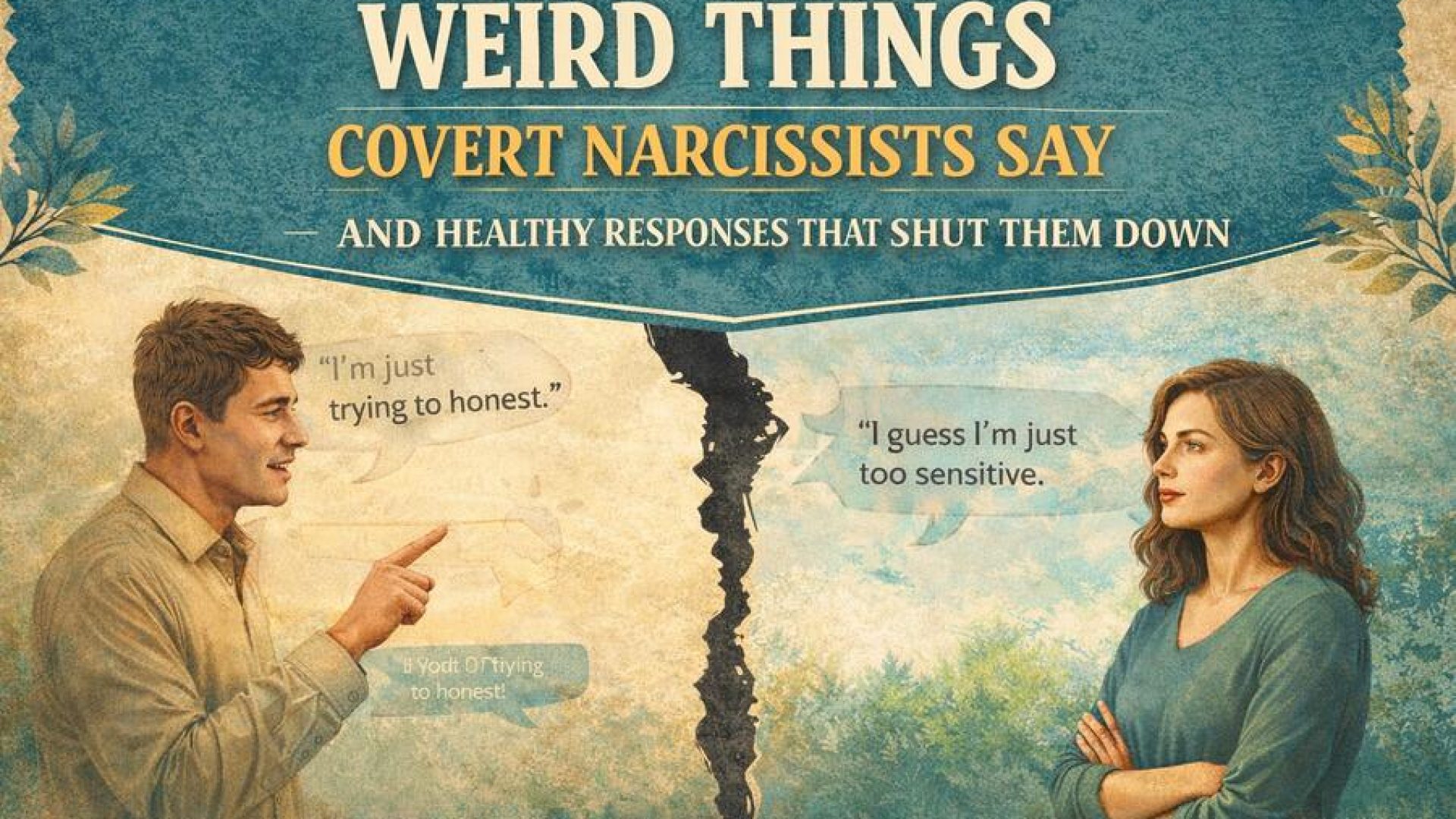
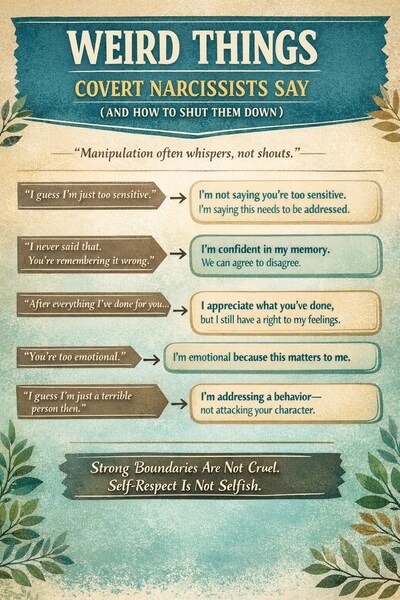
1. “I think I am just too sensitive.”
Translation: “Please comfort me so I don’t have to take accountability”.
This statement is an emotional bait. It invites you to reassure, minimize your own feelings, and shift focus back to their distress.
Healthy response that shuts it down: “I am not saying you are too sensitive. I am saying this situation needs to be addressed”.
Why does this work?
You refuse the emotional trap without attacking. You stay grounded in the issue, not their self-pity.
2. “I never said that. You are remembering it all wrong.”
Translation: This is gaslighting, in every way —clinically and unequivocally.
Gaslighting destabilizes your sense of reality. As time passes, the patient describes feeling “foggy”, “confused”, or emotionally dependent on the narcissist for truth.
Healthy response that shuts it down: “I am confident in my memory. We can safely agree to disagree”.
Why does it work?
You don’t debate facts. You assert internal certainty — something gaslighting fails to penetrate.
3. “After all that I have done for you…”
Translation: “Your boundaries show you are a thankless person.”
This phrase weaponizes generosity. In clinical terms, it creates obligation-based control, not genuine reciprocity.
Healthy response that shuts it down: “I appreciate what you have done. That doesn’t downplay my right to feel this way.”
This response maintains gratitude without surrendering autonomy.
4. “I am just being honest, whether you believe it or not.”
Translation: “Honesty without empathy is not honesty — it is cruelty with a halo.”
Covert Narcissists often disguise emotional aggression as “truth-telling.”
Healthy response that shuts it down: “Honesty is helpful when it’s respectful. This doesn’t feel respectful to me in any way.”
This reframes honesty as relational, not absolute.
5. “You are too emotional.”
Translation: “Said calmly. Designed to silence.”
Emotion-shaming is particularly damaging for individuals with anxious attachment style or a history of traumatic life events.
Healthy response that shuts it down: “I am emotional because this matters to me — not because I am wrong.”
Emotion is not a disease. It is information on how you feel and why you feel what you feel.
6. “No one else seems to have a problem with me or my attitude except for you.”
Translation: “Social comparison as psychological pressure.”
This statement isolates you from everyone around and subtly suggests that you are the culprit.
Healthy response that shuts it down: “I am not responsible for other people’s experiences with you. I am only concerned about mine.”
You reject triangulation. You stay focused on the matter at hand.
7. “You are misunderstanding me, this is really not how it seems to be.”
Translation: “Repeated often enough, it trains your brain to mistrust your comprehension.”
This simply means that you can never trust your judgment, so you should stop believing in what your mind tells you.
Healthy response that shuts it down: “This is how I perceived it. If you mean something else, you can clarify it to me by all means — without dismissing me.”
You invite clarity without self-erasure.
Why Do These Responses Actually Work?
As a Resident Psychiatrist, I always emphasize something crucial:
Healthy responses to weird things Covert Narcissists say are not designed to change the narcissist. They are designed to stabilize you. They are self-regulation and reality-anchoring strategies.
From a clinical perspective, Covert Narcissistic interactions operate on three psychological mechanisms:
1. They hijack the nervous system.
Covert Narcissists unconsciously provoke emotional dysregulation in others — confusion, guilt, anxiety, urgency. When you are dysregulated, your prefrontal cortex (logic, judgement, boundaries) shuts down, and your limbic system (emotion, threat response) takes over.
Precise, calm, and grounded responses:
- Reduce emotional arousal.
- Prevent escalation.
- Keep your nervous system in control.
This is why excessive explanation never works — it perpetuates the dysregulation loop.
2. They depend on emotional supply, not resolution.
From a psychological perspective, narcissistic supply is not just praise. It is any form of emotional engagement.
Defending yourself.
Explaining how you feel.
Trying to make sense of everything and being understood in the process.
All of these can unintentionally serve as a supply.
Healthy responses to weird things Covert Narcissists say work because they:
- Do not offer emotional fuel.
- Do not invite prolonged debate.
- Do not reward manipulation with intensity.
You are no longer taking part in the psychological economy they rely on.
3. They target identity, not just feelings.
Covet Narcissistic language subtly attacks:
- Your emotional legitimacy. (“You are too sensitive”)
- Your internal authority. (“After everything I have done for you”)
- Your perception. (“You are misunderstanding me”)
Over time, this creates identity corrosion, not just sadness.
Clinically sound responses re-anchor you to:
- Your emotional stability.
- Your experience.
- Your perception.
You are no longer questioning, “Am I allowed to feel this?”
You are stating, “This is how it is for me.”
And that shift is profoundly stabilizing.
The Emotional Aftermath No One Talks About
In my clinical experience and in my own lived experience, the most bitter part of Covert Narcissistic abuse is not what happens during the relationship.
It is what lingers after.
1. The grief without a villain.
Many survivors tell me:
“But they weren’t always cruel. Sometimes they were kind.”
This creates ambiguous loss — grief without clear justification. You mourn someone who almost loved you, someone you keep trying to forgive and understand.
This kind of grief is psychologically exhausting because it never feels complete.
2. Post-abusive hypervigilance.
After a prolonged covert manipulation, the brain learns to scan constantly:
- Silence.
- Tone.
- Mood shifts.
- Facial expressions.
This is not overthinking.
This is a conditioned survival response.
Clinically, this resembles trauma-related hyperarousal — especially in individuals who have an anxious-avoidant attachment style or history of traumatic life events.
3. Loss of spontaneity and voice.
One of the most heartbreaking aftermaths I see is this sentence:
“I don’t know who I am anymore.”
Survivors often become:
- Afraid of saying the “wrong” thing.
- Excessively careful.
- Disconnected from joy and playfulness.
Because for a long time, authenticity felt unsafe.
4. Shame for staying.
This is hardly ever talked about — but deeply present.
Highly intelligent, empathic, capable people often feel intense shame for:
- Missing red flags.
- Not leaving the narcissist sooner.
- Still missing the toxic person.
This shame is the misplaced responsibility.
Trauma bonding, intermittent reinforcement, and emotional invalidation impair judgment — they do not reflect weakness.
5. The slow, quiet rebuilding
Healing from Covert Narcissistic abuse is not dramatic.
It looks like:
- Choosing peace over explanation.
- Trusting your perception again.
- Feeling anger without guilt.
- Speaking without rehearsing.
And one day, you realize:
You are no longer arguing in your head with someone who doesn’t have access to you.
Now that is recovery.
Final Words
If you are reading this and quietly nodding, I want you to pause and take a deep breath.
You are not “too sensitive”.
You are not “imagining things”.
You are not broken for struggling to respond perfectly.
Covert Narcissistic abuse is difficult precisely because it targets the most beautiful parts of us — empathy, hope, and patience.
But awareness changes everything.
And every time you choose a calm, self-honoring response to weird things Cover Narcissists say, you are not just shutting down manipulation — you are coming home to your lost self.
FAQs
1. Why do I still miss someone who hurt me?
Trauma bonding creates emotional attachment through inconsistency — affection followed by withdrawal. The nervous system becomes conditioned to crave resolution.
2. Can Covert Narcissistic abuse affect physical health?
Yes. Chronic stress can contribute to headaches, GI disturbances, fatigue, sleep dysregulation, and lowered immunity.
3. Should I confront a Covert Narcissist with what I have learned?
Only if it serves your closure — not as an attempt to change them. Often, insight provokes defensiveness rather than accountability.
4. Will I ever trust myself again?
Yes — often more deeply than before. Survivors frequently develop stronger intuition, boundaries, and emotional literacy.
5. What kind of therapy is most beneficial?
Trauma-informed therapy, schema therapy, and attachment-focused approaches are particularly effective.
References

Dr. Talia Siddiq is a resident psychiatrist in training at Dr. Ruth K.M. Pfau Civil Hospital Karachi, deeply passionate about understanding the human mind and helping people find healing. Beyond her clinical work, she is also a writer who believes that mental health conversations should be easy, relatable, and stigma-free.
She started writing in 2020, turning her reflections and experiences into articles that speak to the struggles many young people silently face—whether it’s self-harm, addictions, relationships, or simply finding direction in life. Over time, her writing has expanded into areas like career guidance and financial independence, because she strongly believes that resilience isn’t just about surviving emotionally—it’s about building a meaningful, balanced life.
For Talia, YouthTableTalk is more than a blog. It’s a safe corner on the internet where young people can pause, reflect, and feel understood. Her goal is not to lecture but to have a conversation—just like a friend who listens, shares, and gently guides you toward growth.
When she isn’t studying psychiatry or writing, you’ll often find her reading, exploring self-growth books, or cooking something new for her family. She brings the same curiosity and compassion to her personal life that she does to her work: always seeking better ways to connect, learn, and inspire.
Through YouthTableTalk, she hopes to remind every reader of one simple truth: you’re not alone, and your story matters.