
When Family Values Become A Weapon
As a resident psychiatrist, I have sat with numerous patients who carry a quiet, confusing grief — one that does not come from the absence of family, but from being emotionally injured within it. As a survivor of narcissistic abuse myself, I know this pain intimately. It is the ache of loving people who speak about family values while simultaneously violating every principle those values are meant to uphold.
What makes Covert Narcissism particularly insidious is its language. It is not loud. It does not shout. It whispers moral superiority while slowly eroding your sense of self. Over the years, both professionally and personally, I have learned to spot weird things Covert Narcissists say — especially when they speak in the name of family, tradition, loyalty, and sacrifice.
I want to tell you beforehand that this article is not about vilifying families. It is about exposing how distorted ideas of “family values” are often used as tools of control, shame, and emotional manipulation — while appearing virtuous on the surface.
“Not all abuse is violent. Some of it arrives dressed as responsibility, culture, and love.”
The Illusion Of Moral Superiority
One of the most common weird things Covert Narcissists say about family values is:
“I believe in family more than anyone else does.”
On the surface, this sounds admirable. But underneath, it often carries a subtle accusation: If you dare to disagree with me, you are immoral, selfish, or disloyal.
Covert Narcissists don’t simply value family — they monopolize the definition of it. Their version of family values leaves no room for boundaries, individuality, and emotional autonomy. In clinical terms, this reflects moral grandiosity, where the individual positions themselves as the ethical authority while invalidating others’ emotional realities.
I have seen patients crumble under the weight of this false moral hierarchy, especially in collectivist cultures where family loyalty is already deeply emphasized.
“Family Stays Together No Matter What”
This phrase is one of the most damaging, weird things Covert Narcissists say — because it minimizes accountability.
What they really mean is:
- You are not allowed to leave, question, or heal.
- A parent has all the rights to make decisions about your life.
- My behavior is exempt from consequences.
- You must tolerate mistreatment.
- A parent is a parent, and they can never want bad for you.
In my training, I have seen survivors struggling with intense guilt for choosing distance or setting boundaries. They fear being labeled thankless, cold, or disloyal. Yet psychologically speaking, healthy family systems allow differentiation — the ability to remain emotionally connected without self-betrayal.
“Staying should never cost you your sanity.”
For a deeper knowledge of narcissistic family dynamics, I often recommend a source on Psychology Today.
Using Culture & Traditional Values As Emotional Leverage
Another pattern I consistently observe is how Covert Narcissists cloak control in cultural righteousness:
“This is how families like ours function.”
“You wouldn’t understand — you’re too modern.”
Here, tradition becomes a shield against introspection. Any attempt to discuss emotional harm is reframed as rebellion against culture itself. As someone who works within South Asian family systems, I approach this carefully — because culture is not the problem. Emotional misuse of culture is.
Healthy traditions evolve. Abusive ones demand silence.
I have written extensively about emotional manipulation within family structures on my platform, Youth Table Talk, where we explore how toxic family systems cause trauma and pass it on to future generations under the label of family values.
“I Sacrificed Everything For This Family.”
This statement deserves special attention because it often evokes instant guilt. It is one of the most emotionally charged, weird things Covert Narcissists say.
Sacrifice, when genuine, does not demand repayment through emotional obedience. But in narcissistic dynamics, sacrifice becomes transactional:
- My pain matters more than yours.
- I suffered for the stability of this family, so you must comply.
- I gave up everything to raise you, so you owe me.
Clinically speaking, this reflects covert entitlement — the belief that suffering automatically grants moral authority over others. Survivors internalize this and often suppress their own needs to avoid appearing selfish.
“True sacrifice liberates. Manipulative sacrifice enslaves.”
When “Respect” Means Silence
Another red flag statement is:
“In this family, respect comes first.”
But respect, in these contexts, often means:
- Do not question elders.
- Do not express discomfort.
- Do not expose dysfunction.
As a resident psychiatrist, I can easily differentiate between respect and emotional invalidation. Healthy respect allows discussion of concerning issues. Narcissistic “respect” demands submission. Many adult children I treat struggle with anxiety and somatic symptoms because their bodies remember what their mouths were never allowed to say.
For those of you seeking further clinical insight, this article from the National Institutes Of Health explains how emotional invalidation impacts mental health.
The Emotional Cost Of Idealizing Family At All Costs
One of the most bitter realizations — for me and for many survivors — is that family values were never meant to require self-erasure.
Yet weird things Covert Narcissists say often romanticize endurance over healing:
“Every family has problems.”
“You are overreacting.”
“You are too sensitive.”
These phrases minimize legitimate psychological injury. Over time, survivors begin to doubt their own emotional perceptions — a phenomenon known as gaslighting. The outcome is chronic self-doubt, depression, and difficulty trusting future relationships.
“You are not weak for noticing what hurts you.”
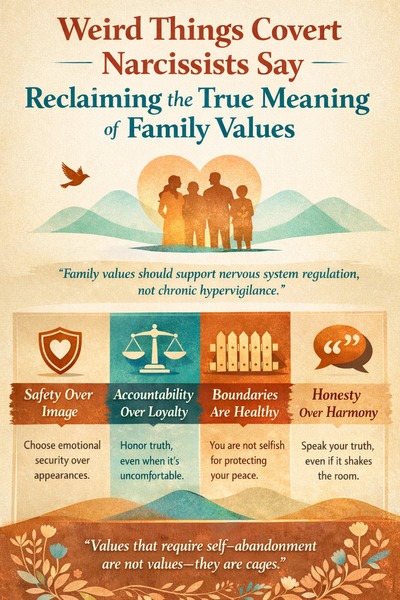
Reclaiming The True Meaning Of Family Values
In both my personal and professional journey, healing began when I redefined family values for myself:
- Safety over reputation/image.
- Accountability over loyalty.
- Compassion over control.
True family values do not fear boundaries. They do not punish honesty. They do not demand silence in the face of harm. Healthy families allow room for disagreement without labeling it as betrayal. They do not demand that one family member shrink so others can feel powerful.
“Family should be where your nervous system can finally rest.”
One of the most liberating realizations in my healing journey was this:
Family values should support nervous system regulation, not chronic hyper vigilance.
If a family environment keeps you anxious, guilty, or perceptually self-doubting, something fundamental is broken — no matter how “respectable” it appears from outside.
“Values that require self-abandonment are not values — they are cages.”
Reclaiming family values often means redefining them on your own terms:
Choosing honesty over harmony, boundaries over obligation, and emotional truth over appearances.
Healing does not always mean cutting ties — but it always means choosing truth over illusion.
Naming The Unspoken Is An Act Of Courage
Writing this as both a psychiatrist and a survivor is deeply personal. I know how terrifying it feels to question narratives that were handed to you as sacred. But I also know this:
Awareness is the beginning of liberation.
When you start recognizing weird things Covert Narcissists say about family values, you are not betraying your family — you are protecting your mental health. And that, too, is a value worth defending.
“You are allowed to outgrow stories that were written to keep you small.”
FAQs
1. Why do Covert Narcissists emphasize family values so much?
Because it provides cover for moral cover for emotional control and dominance.
2. Can someone value family and still be a narcissist?
Yes — what matters is whether values are used to nurture or manipulate.
3. Is setting boundaries against family members selfish?
No, boundaries are a sign of a healthy psyche.
4. Why does guilt feel overwhelming when distancing from such families?
Because guilt had been conditioned as a control mechanism.
5. Can therapy help survivors of narcissistic family dynamics?
Absolutely. Trauma-informed therapy is especially effective.
References
- Psychology Today – Narcissistic Family Dynamics
- National Institutes of Health – Emotional Invalidation and Mental Health
- American Psychological Association – Narcissistic Personality Disorder

Dr. Talia Siddiq is a resident psychiatrist in training at Dr. Ruth K.M. Pfau Civil Hospital Karachi, deeply passionate about understanding the human mind and helping people find healing. Beyond her clinical work, she is also a writer who believes that mental health conversations should be easy, relatable, and stigma-free.
She started writing in 2020, turning her reflections and experiences into articles that speak to the struggles many young people silently face—whether it’s self-harm, addictions, relationships, or simply finding direction in life. Over time, her writing has expanded into areas like career guidance and financial independence, because she strongly believes that resilience isn’t just about surviving emotionally—it’s about building a meaningful, balanced life.
For Talia, YouthTableTalk is more than a blog. It’s a safe corner on the internet where young people can pause, reflect, and feel understood. Her goal is not to lecture but to have a conversation—just like a friend who listens, shares, and gently guides you toward growth.
When she isn’t studying psychiatry or writing, you’ll often find her reading, exploring self-growth books, or cooking something new for her family. She brings the same curiosity and compassion to her personal life that she does to her work: always seeking better ways to connect, learn, and inspire.
Through YouthTableTalk, she hopes to remind every reader of one simple truth: you’re not alone, and your story matters.