As a Resident Psychiatrist who has walked the labyrinth of human minds, and someone who has personally survived the quiet, corrosive shadow of narcissistic abuse, I have come to notice patterns that often escape the casual observer. It is in the subtleties, the almost imperceptible slips of language, that Covert Narcissists reveal themselves. These are not glaring, flamboyant declarations of grandiosity that people typically expect from narcissists — they are whispers, veiled jabs, and strangely “weird” comments that leave the recipient questioning their own reality.
In this article, I want to explore the weird things Covert Narcissists say, as I have seen them manifest in therapy rooms, support groups, and even within my own life, offering both professional and personal insight.
The Quiet Architecture Of Psychological Control
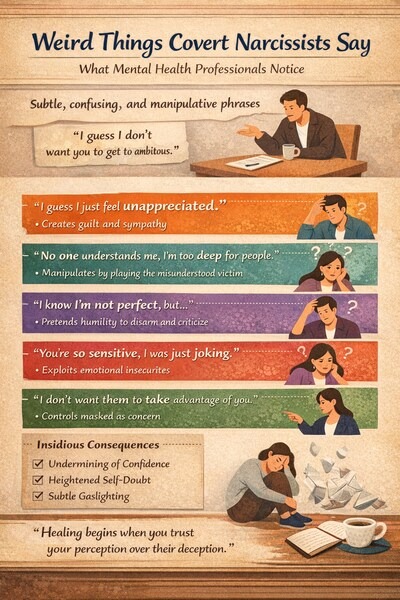
The first thing I notice is that these statements are rarely direct. Covert Narcissists thrive in ambiguity. They say things that can sound benign, even caring, but carry an undercurrent of manipulation or subtle control. For instance, one of my patients recounted an interaction with her partner: “I just think you are happier when you don’t push yourself so hard”.
On the surface, it sounds almost like a concern. Yet beneath it lies envy and an attempt to curb her growth. Clinically, such remarks are insidious — they chip away at a person’s confidence, leaving them to second-guess their own aspirations. This pattern is well-documented in psychological literature on vulnerable narcissism, which emphasizes indirect aggression and passive manipulation. Check out Psychology Today for it.
What makes these comments so effective is their plausibility. If confronted, the speaker can easily deny harmful intent. As a mental health expert, I watch survivors struggle not because they don’t understand what was said, but because they were taught to distrust their emotional reaction to it.
When Truth Becomes A Weapon: “I Am Just Being Honest”
Among the most common weird things Covert Narcissists say are statements framed as radical honesty.
“I’m just saying what everyone else is thinking.”
“I’d rather be honest than fake.”
In therapy, I often take a pause here. Honesty without empathy is not honesty — it is emotional aggression disguised as virtue. These statements function to absolve the speaker of responsibility while placing the burden of emotional regulation on the listener.
From a psychiatric standpoint, this tactic invalidates emotional boundaries. Survivors internalize the belief that discomfort equals weakness, rather than recognizing that discomfort is a legitimate signal of harm. The American Psychiatric Association explicitly identifies this form of communication as emotionally abusive when it consistently undermines self-worth.
The Subtle Undermining Of Achievement
Another pattern I repeatedly encounter is the minimization of success. A patient once told me her partner responded to her promotion with:
“Well, you were lucky. The system favors naive people like you.”
The clinical impact of such remarks is profound. They erode self-efficacy while preserving the narcissist’s fragile self-image. Success becomes something external, accidental, or somehow undeserved.
As someone who has personally absorbed these messages, I know how they distort identity. You stop celebrating yourself. You preemptively downplay your achievements. This is not humility — it is learned invisibility.
Weaponized Vulnerability: “No One Ever Cares About Me”
Covert Narcissists often speak the language of woundedness fluently.
“I guess I’m just too much for people.”
“Everyone leaves me eventually.”
These statements evoke kindness — but they are rarely followed by accountability. Clinically, I view this as a strategic vulnerability. It pulls the listener into a babysitting role while quietly absolving the speaker of relationship responsibility.
Survivors often feel cruel for setting boundaries against someone who appears so delicate. Yet fragility that consistently harms others is not innocence — it is sheer manipulation.
Gaslighting In Soft Focus
Unlike overt gaslighting, Covert Narcissistic gaslighting is subtle.
“You’re remembering it wrong.”
“You’re too sensitive of late.”
What makes these phrases particularly damaging is their cumulative effect. Individually, they seem trivial. Collectively, they dismantle trust in one’s own perception. In my learning and exposure so far, I see how this leads to chronic self-doubt, anxiety, and a persistent need for external validation.
My patients often say:
“I don’t know why, but I feel like I’m always wrong.”
That sentence alone tells me everything.
Moral Superiority Disguised As Care
One of the most psychologically sophisticated patterns involves moral framing.
“I’m only saying this because I care about your reputation.”
“I wouldn’t want you to embarrass yourself.”
These are not neutral statements. They subtly position the narcissist as wiser, more discerning, and morally superior. Over time, the survivor internalizes a belief that autonomy equals recklessness.
I often discuss this dynamic in my writing on Youth Table Talk because reclaiming autonomy after narcissistic abuse requires unlearning the false belief that obedience equals safety.
Why Do These Statements Feel So Confusing?
What makes the weird things Covert Narcissists say so destabilizing is their inconsistency. Warmth alternates with withdrawal. Praise is followed by critique. This intermittent reinforcement creates emotional dependence — a phenomenon well-known in trauma psychology.
As Carl Rogers once wrote,
“The curious paradox is that when I accept myself just as I am, then I can change.”
Survivors cannot heal while constantly negotiating someone else’s emotional terrain.
The Long-Term Psychological Impact
Clinically, prolonged exposure to Covert Narcissistic abuse often results in:
- Pathological self-doubt
- Low self-esteem
- Inability to make decisions independently
- Depression
- Trauma-bonding patterns
- Emotional hypervigilance
- Difficulty in trusting one’s perceptions
Books such as Disarming the Narcissist explore these dynamics in depth and align closely with what I see in therapeutic settings.
Healing Begins With Language Awareness
Healing, for me and for my patients, began the moment language was named. When you recognize a pattern, it loses its power. Journaling conversations, reality-checking with trusted people, and working with a trauma-informed therapist are not overreactions — they are acts of reclamation.
You were not “too sensitive”.
You were perceptive in an environment that punished perception.
A Closing Reflection — From A Healed Nervous System To The Healing One
As both a psychiatrist and someone who has lived through narcissistic abuse, I have learned that the most damaging wounds are rarely caused by what is screamed, but by what is quietly, repeatedly implied. The weird things Covert Narcissists say often sound benign to outsiders. Sometimes, they even sound loving. But to a trained ear — and to a sensitized nervous system — they reveal a consistent pattern of emotional erosion.
What mental health professionals notice is not just the sentence itself, but the after-effect: the confusion that lingers, the self-doubt that takes root, the subtle shrinking of a once-confident self.
I have seen recovery happen. I have lived it too. With awareness, compassion, and the right support, the fog does lift. And when it does, what returns is not just clarity — but yourself.
FAQs
1. Why do these statements intensify when the victim becomes self-aware?
Increased awareness threatens the narcissist’s control and provokes destabilization.
2. How do psychiatrists differentiate gaslighting from normal relational misunderstandings?
By assessing intent, power imbalance, consistency, and impact on the victim’s reality testing.
3. Can therapy help undo the impact of weird things Covert Narcissists say?
Trauma-informed therapy restores self-trust and dismantles internalized manipulation.
4. Is it common for victims to feel guilt after hearing these statements?
Yes, because the language is designed to shift blame while appearing emotionally reasonable.
5. What is the first sign that someone is beginning to heal from Covert Narcissistic abuse?
The moment their confusion turns into clarity rather than self-blame.