

“Obsessive–Compulsive Disorder is not about being neat or organized. It is about being trapped in a mind that refuses to feel safe.”
If you have already read my previous article, “What Are The 4 Types Of OCD? Symptoms You Should Know”, then you know one thing clearly: OCD is not a personality quirk, and it is certainly not a joke. My work today is a continuation to help you understand, with real-life examples, how OCD looks and feels in actuality. Hence, the article today goes beyond the bookish knowledge of What Are The Types Of OCD, What Are The Symptoms Of OCD, and How To Diagnose OCD.
Being a resident psychiatrist, managing OCD is not unique for me. I often hear individuals say, “I don’t know how to make these thoughts stop. I know they don’t make sense, and they are not even real, but I can’t seem to help them”.
So basically, statements like these capture OCD more accurately than any criterion ever could. Insight is often present. Control is not.
So today, I want to answer a common question that comes up repeatedly in my outpatient department as well as my inbox:
What Are The 4 Types Of OCD, and how do they actually manifest in everyday life?
This is not a textbook explanation. It is a human one.
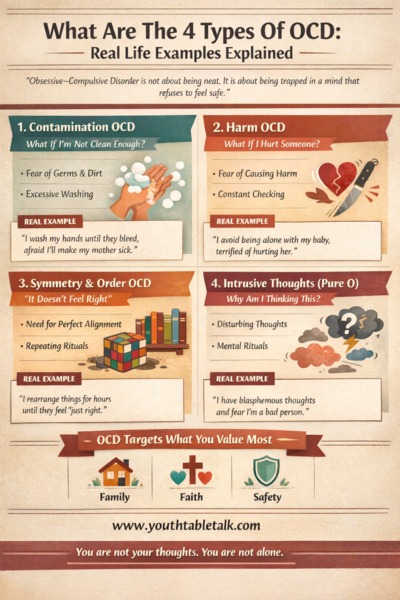
Understanding OCD Beyond Labels
Obsessive-Compulsive Disorder (OCD) is a chronic mental health condition marked by:
- Obsessions: Repetitive, intrusive, unwanted thoughts, images, or urges.
- Compulsions: Repetitive rituals or mental acts performed to reduce distress.
What many people don’t realize is that OCD does not attack randomly. It targets what you value most-health, control, health, morality, faith, or responsibility.
Clinically, OCD is often grouped into four broad categories. These are not rigid boxes, but patterns that help mental health professionals recognize what is happening-and why.
1. “What If I Am Not Clean Enough?”: Contamination Type OCD
“The fear is not dirt. The fear is what dirt might do.”
Contamination OCD is the most common type of OCD and the one that is most misunderstood.
The core obsession is the fear of contracting germs, dirt, bodily fluids, chemicals, or environmental toxins.
To deal with these obsessions, the core compulsions acquired include repeated hand washing, prolonged showers, avoidance of public places or physical contact, and repeated cleaning or sanitizing.
A Real-Life Example
A young woman once came to me with her hands’ skin cracked and bleeding. It was from repeated washing and sanitizing. She washed her hands until they started to bleed from the cracks. This wasn’t because she enjoyed cleanliness, but the thought of not washing made her chest tighten with dread. If she touched the door handle, she felt contaminated, not just physically but also morally, as if he had failed at protecting herself and others.
She sat across from my table in OPD, twisting the edge of her stole.
“Doctor, I wash my hands for hours. But the worst part isn’t the germs. It is the thought that if I don’t, something terrible might happen to my parents”, she anxiously whispered.
What she was describing wasn’t just the fear of contamination. It was an inflated sense of responsibility-the belief that her actions alone stood between safety and catastrophe.
When I said, “Your mind is trying to protect what you love”, she burst into tears. It wasn’t because the OCD was suddenly cured, but because someone finally understood it.
During the COVID-19 pandemic, this subtype intensified dramatically, blurring the line between rational caution and pathological fear. A distinction well explained by the CDC’s overview of Anxiety Disorders.
2. “What If Someone Gets Hurt Because Of Me?”: Harm Type OCD
“The most disturbing thoughts often belong to the gentlest people.”
OCD of Harm is one of the most distressing and tragically one of the most stigmatized forms of OCD.
The core obsession here is the fear of harming oneself or others, intentionally or unintentionally.
To deal with these obsessions, the core compulsions employed include avoiding sharp objects, knives, or driving. Patients also avoid interacting with their loved ones, seek repeated reassurance, and constant mental checking.
A Real-Life Example
A new mother once came to my OPD and told me nervously that she was afraid to be alone with her baby. Intrusive thoughts of harming her infant repeatedly infiltrated her mind, followed by intense guilt and severe panic. She believed the thoughts meant she was not fit to take care of her newborn.
In reality, what distinguished her state was how terrified she felt by the thoughts. Harm OCD attacks a person’s moral core-and then convinces them that having an idea is the same as committing an act.
In between these sessions, another patient once said something that stayed with me:
“I keep checking the stove because I am scared I will burn the house down”, he said.
Then, quietly, “But sometimes I am not even scared… It just doesn’t feel unfinished unless I check again”.
That sentence matters. Because OCD doesn’t always shout danger, sometimes it whispers incompletion.
3. “It Doesn’t Feel Complete: Symmetry & ‘Just Right’ OCD
“The anxiety lives in the imbalance — not the object.”
This subtype revolves around an internal sense that things are not aligned, even, or complete.
The core obsession is an intense need for balance, order, symmetry, or things feeling “just right”.
To deal with these obsessions, the compulsions employed include aligning items precisely, reordering objects repeatedly, repeating actions until discomfort fades, and counting, tapping, or arranging.
A Real-Life Example
One patient spent hours adjusting books on his shelf-not because of beauty or aesthetics, but because his body refused to relax until everything felt aligned. The discomfort was visceral, almost physical, and impossible to ignore.
OCD of Symmetry is often mistaken for perfectionism. In reality, it is driven by sensory distress, not preference.
And often, it doesn’t exist alone.
4. “Why Am I Thinking This?”: Intrusive Thoughts/ Pure O OCD
“Thoughts are not actions — but OCD convinces you otherwise.”
Pure Obsessional OCD, or Pure O, involves intrusive thoughts with zero to minimal visible compulsions. The rituals happen internally, which makes this subtype especially isolating.
The core obsessions in this type are sexual intrusive thoughts, religious or blasphemous thoughts, and moral or existential doubts.
The mental compulsions acquired to deal with these obsessions include mental reviewing, reassurance seeking, thought suppression, and excessive rumination.
A Real-Life Example
A deeply religious patient once told me she felt terrified during prayer. Blasphemous thoughts intruded relentlessly, followed by hours of silent mental apologies. She believed the thoughts meant she was sinful.
She was trembling as she said, “Doctor, my room has to be perfect. But the thoughts in my head are worse. If the thoughts in my head were visible, people would never talk to me again”.
This is where OCD turns cruel-when suffering becomes invisible, and shame prevents disclosure.
For culturally sensitive discussions like What Are The 4 Types Of OCD and other mental health topics, YouthTableTalk is open for you, as this platform is compassionate and judgment-free.
Why Do These Types Of OCD Often Overlap?
One important clinical truth you need to know is that the majority of individuals suffering from OCD do not fit perfectly into a single best category.
A person with Contamination-type OCD may also experience harm-related intrusive thoughts. Someone with OCD of Symmetry may engage in mental checking. OCD is fluid, not fixed.
Understanding What Are The 4 Types Of OCD is not about labeling people. It is about identifying patterns of fear and relief that maintain the disorder.
The most effective management remains Cognitive Behavioral Therapy (CBT), Exposure & Response Prevention (ERP), often combined with Antidepressants (SSRIs). It is a recommendation you can check out at the American Psychiatric Association.
The Last Words That Will Stay With You
“OCD does not arrive loudly. It disguises itself as concern, responsibility, cleanliness, morality — and then demands obedience.”
Being a Resident Psychiatrist, I have learned that the most painful part of OCD is not the compulsions themselves, but the loneliness they create. Patients rarely say, “I am afraid.” Instead, they say, “I don’t trust my own mind.”
Recovery from OCD does not mean eliminating intrusive thoughts. It means learning to stand with courage while anxiety rises and falls, without surrendering to it.
I have seen patients reclaim hours of their day. I have watched parents hold their children again. I have seen faith restored, not by silencing thoughts, but by refusing to bow to them.
If there is one message I want you to carry with you, it’s this:
You are not failing because you have OCD.
You are surviving despite it.
And with understanding, evidence-based treatment, and compassion-survival can slowly become living.
FAQs
1. Can OCD really look different from person to person?
Yes. OCD themes vary widely, but the underlying cycle of obsession and compulsion is the same.
2. Why do OCD thoughts feel so real and convincing?
OCD activates the brain’s threat system, making thoughts feel urgent and dangerous.
3. Are intrusive thoughts a sign of hidden desires?
No, not at all. Intrusive thoughts are unwanted and usually target what a person fears the most.
4. Why does resisting compulsions feel unbearable at first?
Because anxiety peaks before it naturally falls-a process central to ERP treatment.
5. Why do OCD urges feel urgent rather than optional?
Because the brain mislabels intrusive thoughts as immediate threats.