

“The mind can become a prison when fear is given a key.”
As a psychiatrist, I often encounter people who walk into my OPD carrying an invisible burden. They look articulate, composed, and sometimes even cheerful, but deep down, their thoughts are loud, repetitive, and exhausting. Many of them hesitate before saying the words, “Doctor, I think there is something really wrong with my head”.
What they often describe is Obsessive-Compulsive Disorder (OCD), a common condition that is frequently misunderstood, and painfully misinterpreted in popular culture, especially West, including the US.
OCD is not about cleanliness alone. It is not a personality trait. It is not a preference for order or symmetry. OCD is about distress, intrusion into the mind, and loss of control over one’s own thoughts.
In this beginner-friendly yet clinically grounded guide, I want to answer a question I hear almost daily:
“What Are The 4 Types Of OCD?”
To help you deal with your curiosity, I will walk you through them clinically, compassionately, and calmly-because understanding OCD is often the first step towards healing.
Understanding OCD Before We Classify It
OCD is a mental health disorder that is essentially comprised of two components:
- Obsessions: Repeated, recurrent, intrusive, unwanted thoughts, images, or urges that cause significant anxiety.
- Compulsions: Repetitive behaviors or rituals performed to reduce the anxiety caused by the obsessions.
Clinically, OCD lies on a spectrum, and symptoms often overlap. However, for clarity, learning and education, mental health experts commonly describe OCD in four major symptom-based categories.
So, are you ready to explore them, one by one?
What Are The Four Types Of OCD? Little Overview
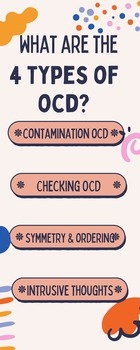
Before we dive into the depths of this giant ocean of OCD, here is a simple overview:
- Contamination OCD
- Checking OCD
- Symmetry and Ordering OCD
- Intrusive Thoughts (Pure Obsessional OCD)
Now let me take you inside each type, not just as bookish knowledge, but as lived experiences.
1. Contamination OCD: When The World Feels Unsafe
“I wash my hands not because they are dirty, but because my mind tells me they are dirty and dangerous.”
This is the most publicly recognized form of OCD-and yet, it is still widely misunderstood.
Core Obsession:
Fear of contamination from bodily fluids, germs, chemicals, or even “emotional contamination” from certain people and places.
Common Compulsions:
- Repeated handwashing.
- Excessive showering.
- Avoiding public places.
- Disinfecting objects repeatedly.
But here is what people don’t see:
The fear has no logical explanation-it is existential. Patients often tell me, “I know it doesn’t make any sense, but I can’t seem to stop”.
In severe cases, Contamination OCD can shrink a person’s world until it fits inside a single “safe room”.
You can read more about how anxiety disorders overlap with daily life stressors on Verywell Mind.
2. Checking OCD: When Doubt Becomes Relentless
“The doubt is never satisfied. It always asks one more question.”
Checking OCD is fueled by an overwhelming fear of harm and responsibility for that harm.
Core Obsession:
“What if I made a mistake that could hurt somebody?”
Core Compulsions:
- Repeated checking of door locks, gas stoves, switchboards, and sockets.
- Seeking Reassurance from others.
- Mental reviewing of past actions.
- Rereading messages or going through emails.
What fascinates me clinically is that these patients are often extremely conscientious and morally driven individuals. Their OCD hijacks their sense of responsibility and turns it into self-punishment.
No amount of checking brings certainty-because OCD is not a disorder of safety, but a disorder of intolerance of uncertainty.
3. Symmetry & Ordering OCD: When “Just Right” Is Never Right Enough
“My discomfort isn’t visual—it’s visceral.”
This type of OCD is often mistaken for perfectionism. Well, trust me, it’s not.
Core Obsession:
A distressing sense that things are unorganized, uneven, incomplete, or “wrong”.
Core Compulsions:
- Extreme discomfort when a particular routine is disturbed.
- Continuous tapping, counting, or aligning items.
- Arranging objects symmetrically.
- Repeating actions in a particular manner until they feel “just right.”
Patients describe it as an internal itch, not anxiety about harm, but unbearable discomfort if things are not aligned internally as well as externally.
Most importantly, you need to know that this is not merely for the purpose of aesthetics. It is about the immense discomfort at the neurobiological level, demanding immediate relief.
4. Intrusive Thoughts (Pure Obsessional OCD): When The Mind Targets Itself
“I am not my thoughts—but they don’t stop accusing me.”
This is the most misunderstood and most painful type of OCD.
Often called Pure O, this form involves obsessions without visible compulsions. But make no mistake: the compulsions do exist-they are mental!
Core Obsessions May Include:
- Intrusive sexual thoughts.
- Violent thoughts or thoughts of harming others.
- Fear of becoming immoral or “bad.”
- Religious or blasphemous thoughts.
Mental Compulsions:
- Mental reviewing.
- Praying excessively.
- Constant self-assurance.
- Avoiding triggers.
- Thought suppression (which paradoxically makes the symptoms worse).
As a resident psychiatrist, I want to say this out loud and clear:
“Having repetitive, intrusive thoughts does NOT reflect your character, morality, or intentions.”
In fact, the more disturbed a person is by these thoughts, the less likely they are to act on them.
For an excellent clinical explanation of intrusive thoughts, check out this wonderful work at NIMH.
Why Do These Types Overlap More Than You Think?
It is highly unlikely for most people to fit into any one category perfectly.
A patient may:
- Fear contamination and engage in checking behaviors.
- Have intrusive thoughts and symmetry compulsions.
Our brain does not follow diagnostic checklists for God’s sake. It follows fear pathways, i.e, “If I don’t do this, that will happen”.
That is why modern-day psychiatry treats OCD based on symptom dimensions, not labels alone.
Treatment Works-Even When OCD Tells You Otherwise
“OCD’s loudest symptom is not fear—it is hopelessness disguised as logic.”
One of the most brutally testing moments in my clinical work is when a patient looks at me hopelessly and says, “Doctor, I have tried everything in my capacity. Perhaps this is just how my brain is”. This sentence doesn’t come from evidence; it comes from OCD itself.
OCD is uniquely cruel because it doesn’t just generate anxiety; it attacks the idea of getting better. It has the potential to convince individuals that treatment will fail, that therapists will not understand, and that medications will change their personality, or that improvement will somehow mean losing control over their routine and life. Well, let me tell you that these are not the objective concerns; they are symptoms.
From a clinical standpoint, OCD is one of the most treatable psychiatric disorders when approached in the right way. The Gold Standard Treatment is Cognitive Behavioral Therapy with Exposure and Response Prevention. Pharmacological treatment, particularly Antidepressants (SSRIs), also works well in the management of OCD.
I have seen patients who once spent hours trapped in rituals return to work, rebuild relationships, pray without fear, and sleep well without mental warfare. Progress is not always linear, but it is real.
A Gentle Word If You Recognized Yourself Or Your Loved One Here
“If a description hurts because it feels familiar, that recognition itself is not a diagnosis—it is an invitation.”
If, while reading this article, you felt a quiet tightening in your chest or an urge to reread certain lines, I want to pause here with you. Recognition can feel unsettling. Not because something is wrong with you, per se, but because it finally has a name.
People with OCD are often deeply introspective, conscientious, and morally sensitive. Ironically, these strengths become the very levers OCD pulls to create distress. This mental health condition feeds on what you value the most-faith, love, responsibility, safety, or goodness-and then convinces you that you are failing at each one of them.
Having intrusive thoughts does not mean you want them. Performing compulsions does not mean you are weak. Avoidance doesn’t mean you are incapable. These are learned responses to fear-and learned responses can be unlearned with courage and practice.
Seeking professional help doesn’t mean your symptoms are “severe enough”. There is no minimum threshold of suffering required to deserve care. If OCD is interfering with your daily life, your peace of mind, your relationships, or your ability to live to the fullest, that is reason enough.
And if you are not ready yet, YouthTableTalk is here for you. Even awareness is movement.
Healing rarely begins with certainty.
It begins with permission to challenge fear, to tolerate discomfort, and to imagine a life not ruled by compulsions.
If you recognized yourself in the write-up here, you are already further along than OCD wants you to believe.
FAQs
1. Can OCD change its type over time?
Yes. OCD symptoms often evolve depending on the stress level, adverse life events, and untreated anxiety.
2. Is Pure O more dangerous than any other type?
No. Intrusive thoughts do not predict actions. They reflect anxiety, not intent.
3. Can someone have all four types of OCD?
Yes. Many patients experience overlapping symptom dimensions.
4. Is OCD lifelong?
Not necessarily. With proper treatment, many people experience long-term remission.
5. Can stress trigger OCD symptoms?
Absolutely. Stress doesn’t cause OCD, but it can significantly worsen the symptoms.