

As a Resident Psychiatrist and as an individual who has walked through my own storms, I often return to the Diathesis Stress Model when I try to make sense of youth mental health. It is one of those unique frameworks that feels both scientific and deeply human. In my previous article, “5 Key Facts About The Diathesis Stress Model”, I laid the foundation of how vulnerability and stress interact to cause a mental illness.
Today, we will explore how this model beautifully and compassionately explains what many young people and teenagers experience every day.
I am writing this piece from the core of my heart, from my Outpatient Department, and from years of watching the emotional landscape of adolescents slowly unfold. And every time, I return to the same truth:
“It is not the load that breaks a person, but the way the load lands on a vulnerable ground.”
Let’s walk through several powerful ways the Diathesis Stress Model makes sense of youth mental health and why understanding it can change how we support the next generation.
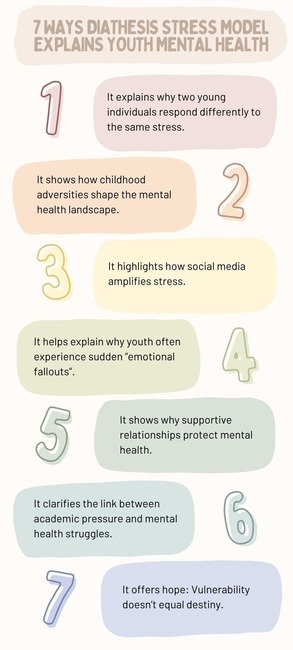
1. It Explains Why Two Young People Respond Differently To The Same Stressor.
One of the most humbling lessons in my clinical practice is this:
Two teenagers can go through exactly similar event-failure, heartbreak, bullying-and emerge with completely different mental health outcomes.
The Diathesis Stress Model clarifies this amazingly.
According to this model, mental health outcomes depend on two factors:
- Diathesis: Biological, Psychological, or Genetic vulnerability.
- Stress: Environmental or life pressures.
A teenager with a strong biological or psychological predisposition may develop depression after a breakup or exam failure, while the other one with a lower diathesis may recover naturally.
This doesn’t make one individual weaker than the other-it simply means the starting points for both are different.
As I often tell youngsters attending my clinic:
“Your reaction is not your fault; it is your story combined with your biology.”
2. It Shows How Childhood Adversities Shape The Mental Health Landscape.
The adolescent brain is still in the process of sculpting itself. Neural pathways are malleable, emotions are intense, and self-worth is fragile. When stress shows up early in life (be it conflict, neglect, or instability), it increases the diathesis for later disorders.
Thanks to advances in neurobiology, we know that:
- The Hypothalamic-Pituitary-Adrenal axis becomes hyperactive.
- Early life trauma sensitizes the stress-response system.
- Amygdala responses gain intensity.
- Prefrontal regulation becomes compromised.
This makes youth more susceptible to anxiety, mood disorders, and emotional dysregulation.
The Diathesis Stress Model validates something many trauma survivors struggle with:
“Your reactions are not overreactions—they are adaptations shaped by what you survived.”
For a beautifully simplified breakdown of trauma and neurobiology, you can explore this helpful guide at Brainline.
3. It Highlights How Social Media Amplifies Stress.
Social Media has silently become one of the most potent environmental stressors of our time.
Instant feedback loops.
Online aggression and hostility.
Curated perfection.
Comparison spirals.
For a young individual who already carries a mild diathesis, let’s say, mild anxiety or self-esteem issues, social media serves as a fuel added to a slow-burning fire.
I have seen adolescents who appear resilient at a surface level but crumble under the invisible weight of online performance. This makes the Diathesis Stress Model more relevant than ever: the stressors may have changed shape over time, but the underlying mechanism has not.
A resource worth exploring is this excellent article on digital stress in teens at Healthline.
4. It Helps Explain Why Youth Often Experience Sudden “Emotional Fallouts”.
One of the most worrisome things for families is how abruptly a young person can shift from coping to collapsing.
The Diathesis Stress Model explains that mental health breakdowns occur when:
- Ongoing stress accumulates quietly.
- Coping resources run scarce.
- Vulnerability crosses the threshold.
The collapse may feel sudden, but it is usually the result of collective micro-stressors landing on pre-existing diathesis.
I often describe it to the parents of youngsters like this:
“Your child has been holding on with invisible strings, and today, one of them snapped.”
This understanding reduces blame, enhances compassion, and opens the gateway to interventions such as early screening and detection, stress management, and resilience training.
5. It Shows Us Why Supportive Relationships Protect Mental Health.
One of the most uplifting insights from the Diathesis Stress Model is that stress doesn’t always win.
Protective factors matter immensely.
Supportive relationships can buffer and even neutralize the impact of stress on a vulnerable mind. When I ask the teenagers what helped them survive their hardest battles, they rarely mention treatment or medication. They quote things such as:
- My best friend listened to me for hours without judging.
- My mother didn’t doubt me.
- My teacher had faith in me.
- My partner healed me with their words without attempting to fix me.
Human connection reduces stress intensity and increases coping capacity, effectively lowering the risk of developing mental health disorders.
I would like to remind you, as I do with my young patients:
“Your people can be your medicine.”
6. It Clarifies The Link Between Academic Pressure & Mental Health Struggles.
The youth today face immense academic pressure.
Grades, competition, comparisons, and uncertainty about the future, all of these are powerful environmental stress factors.
When an adolescent has:
- A family history of anxiety
- A genetic predisposition to perfectionism
- Low self-confidence
- Or a tendency towards rumination and excessive worrying thoughts
Academic stress becomes disproportionately overwhelming.
Every year, brilliant young minds walk into my OPD at the edge of an emotional burnout. And every year, the Diathesis Stress Model helps me explain to them why their suffering makes perfect sense.
It is not the lack of willpower.
Neither weakness.
Nor poor character.
It is the interaction between diathesis and chronic academic stress.
7. It Offers Hope: Vulnerability Does Not Equal Destiny.
I believe that the most important message of the Diathesis Stress Model is one of hope.
I am aware that vulnerability exists.
Yes, stress can trigger mental illness.
But vulnerability is not the end of the world; it is simply potential.
With the help of:
- Skill-building
- Supportive environment
- Psychotherapy
- Timely intervention
- Emotional education
- Spiritual grounding
- Healithy lifestyle modifications
- Mindfulness-based practices
Young individuals can dramatically reduce the impact of both diathesis and stress.
This is why I write extensively about youth mental health on my platform YouthTableTalk.
The goal is not to eliminate vulnerability but to empower young minds with the tools to navigate it.
As I often tell teens who feel defeated:
“You are not destined to break. You are destined to learn how to bend.”
Closing Note
As I finish writing this article, I am reminded of the countless young faces I have met. Some are brave, some are fragile, but they have one thing in common. All of them are trying to make sense of their inner storms. The Diathesis Stress Model has been more than an academic framework for me; it has been a lens through which I understand the quiet battles unfolding inside the hearts of our youth.
Every young adult carries a story, a history, a temperament, and a threshold. Some are born with heavier emotional weight, some are shaped by the noise of the world. But none of them are “broken”. They are evolving.
And if there is one truth I want every young person and every parent to remember, it’s this:
“Vulnerability is not weakness. It is the birthplace of resilience, depth, empathy, and growth.”
With compassion, understanding, and timely intervention, vulnerability can transform into strength. The storms are inevitable, but with the right guidance and support, our youth can learn to not just survive them but to rise above them with courage and wisdom.
If this article helps even one young soul feel seen, understood, or less alone, then it has served its purpose.
FAQs
1. How does the Diathesis Stress Model apply to everyday youth behavior?
It helps explain why some adolescents become anxious, depressed, or overwhelmed by typical life stressors while others adapt more easily. It shows that reactions depend on a mix of vulnerability (diathesis) and stress.
2. Can diathesis be changed or reduced?
While biological predispositions may remain, psychological and environmental vulnerabilities can absolutely be reduced through emotional skills, supportive friends and family, healthy habits, stress-management tools, and psychotherapy.
3. Does a high-stress environment always lead to mental illness?
No. Stress alone does not cause mental disorders. It only leads to illness when a vulnerable diathesis is present. Protective factors can also buffer the effects of stress.
4. What are the common stressors in youngsters?
Family history of mental illness, genetic predispositions, childhood trauma, high sensitivity, expressed emotions in the family, perfectionist traits. Insecure attachment and a difficult early environment.
5. How can parents use the Diathesis Stress Model to support their children?
By addressing vulnerability, reducing environmental stress, offering emotional validation, encouraging open communication, and seeking professional help early when symptoms appear.