
Certain concepts in mental health education or Psychiatry don’t just inform my clinical practice; they shape the way I see people, their suffering, and their bravery. The Diathesis Stress Model is one of those concepts.
It is not merely a theoretical framework I studied during the early years of my training; it is a lens through which I understand my patients, my dear ones, and at times, even myself.
I often say to my colleagues, “Human beings are not fragile; they are layered.”
What appears on the surface level rarely tells the full story. The Diathesis Stress Model reminds me of that truth every single day: that vulnerability and resilience coexist within us, constantly interacting with the world around us.
Today, I would like to share some key facts about the Diathesis Stress Model, weaving together clinical science, lived experience, and the compassion that Psychiatric education has taught me over the years. By the end of this discussion, you will see mental health through a gentler, more nuanced lens, and perhaps recognize your own strength in the process.
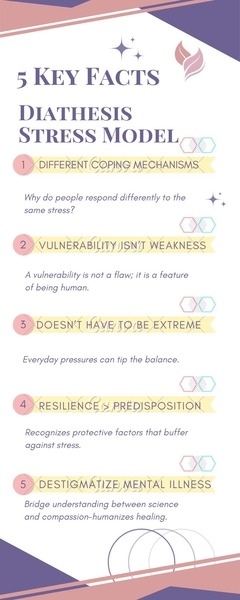
1. The Diathesis Stress Model Explains Why People Respond Differently To The Same Stress.
As a Psychiatrist, one of the most common questions families ask me is: “Why did this happen to my son and not somebody else?”
The Diathesis Stress Model provides a powerful explanation:
We all have different vulnerabilities, and when those vulnerabilities interact with stress, mental illnesses may emerge.
Diathesis refers to predisposition-genetic, psychological, and biological.
Stress refers to the environmental triggers.
And the truth is, no two people carry the same combination.
I have seen siblings raised in the same household respond differently to trauma, one developing depression while the other coping without any major symptoms. I have met resilient individuals who crumble after prolonged stress, and others who flourish despite unimaginable hardships.
What I learned about the Diathesis Stress Model during my training felt like someone handed me a key-not just to understanding my patients, but to understanding humanity, including myself. It explained why empathy is not optional but essential.
Because we never know the weight someone is already trying their best to carry.
To explore the concept in greater psychological detail, you may also read this helpful overview from Verywell Mind.
2. Vulnerability Doesn’t Mean Weakness-It Means Sensitivity To Stress.
One of the most dangerous myths in society is the idea that developing a mental illness means a person is“weak”. I have witnessed the damage this belief causes: stigma, shame, avoidance of seeking treatment, and deep emotional wounds.
But the Diathesis Stress Model teaches us something profoundly compassionate:
“A vulnerability is not a flaw; it is a feature of being human.”
Some individuals have a genetic predisposition-perhaps a family history of Bipolar Affective Disorder or Schizophrenia. Others have psychological diathesis such as perfectionistic tendencies, insecure attachment style, or childhood trauma.
This idea changes how I saw myself as well, since I used to carry a lot of childhood trauma too. There were moments early in my teenage years when I wondered why certain life events felt heavier for me than others. Why I internalized stress differently. Why did emotional burdens linger longer, and was overthinking trivial matters the norm? Learning the Diathesis Stress Model helped me shed my own self-judgement.
It reminded me that being sensitive does not make me weak-it makes me aware. It makes me capable of noticing nuances in my patients. And it makes me deeply human.
3. Stress Doesn’t Have To Be Extreme-Even Everyday Pressures Can Tip The Balance.
It is a common misnomer that mental illnesses are triggered only by some catastrophic events, such as trauma, loss, or accidents. But the reality is different. The Diathesis Stress Model highlights, ordinary stressors can activate vulnerabilities.
Let me walk you through some common triggers:
- Academic demands.
- Peer pressure.
- Caregiver burden.
- Chronic workplace pressure.
- Sleep deprivation.
- Social comparisons.
- Financial constraints.
- Physical illness.
I have seen sharp, high-functioning people break down during residency training-long working hours, lack of rest, and constant pressure of proving your worth slowly eroding their resilience. I have seen mothers who appear “strong” on the outside silently carry emotional exhaustion until it tipped into anxiety and depression.
Stress doesn’t have to announce itself dramatically. Sometimes it is quiet, consistent, and deceptively “normal”-yet powerful enough to activate underlying susceptibility.
This is why timely intervention matters.
And that is why, as Psychiatrists, we don’t just ask about “significant life events”-we ask about every detail.
For more insight into how stress affects mental health, you may read this research-based article by NIMH.
4. Resilience Can Protect You Even If You Have A Predisposition.
A fact that serves as a ray of hope and is very empowering for patients is the protective role of resilience.
The Diathesis Stress Model doesn’t simply focus on vulnerability. It also recognizes protective factors, the strengths that buffer us against stress. These include:
- Supportive family environment.
- Secure relationships.
- Financial stability.
- Sound physical health.
- Strong coping skills.
- A sense of purpose.
- Mindfulness and emotional regulation.
- Faith, meaning, and spiritual connection.
During the early months of my residency, I met a young woman in my OPD with a family history of significant mental illness. According to the Diathesis Stress Model, she carried a substantial risk for developing a psychiatric condition such as Depression. Yet she managed to lead her life with such goodness and insight that she remained psychologically stable even during the difficult times.
When I questioned her about how she stayed so steady, her answer was simply delightful:
“I don’t wait to break before I heal”.
Her statement stayed with me.
Resilience isn’t about being unbreakable-it’s about strengthening the self so that vulnerability doesn’t become destiny. It’s about strengthening your predisposition, honoring your humanity, and building tools that keep you afloat.
5. The Diathesis Stress Model Helps Destigmatize Mental Illness-and Humanizes Healing.
Perhaps the most meaningful contribution of the Diathesis Stress Model is its ability to bridge the understanding between science and compassion. Mental illness is not:
- A character flaw.
- A lack of willpower.
- A spiritual failure.
- A sign of weak nerves.
In essence, it’s the outcome of interactions between vulnerability and stress of which are natural, human, and universal.
Whenever I explain this to my patients and their families, I notice their expressions soften. Suddenly, the shame lifts. They realize that they are not “broken”-they are responding to forces that are both biological and environmental.
This wonderful model not only reframes mental illness-it reshapes recovery and how mental illness should be seen. It encourages a holistic journey:
- It builds resilience.
- It reduces stressors.
- It addresses vulnerabilities (through therapy, medication, and lifestyle changes).
- It cultivates protective factors.
- It nurtures a supportive environment.
In a world that often rushes to judge, the Diathesis Stress Model reminds us to pause and choose compassion instead.
If you wish to explore more reflective mental-health content, feel free to pay a visit to YouthTableTalk.
Healing Takeaway!
Writing this piece brought me back to the roots of why I chose to pursue my career in Psychiatry. It was solely to understand the human mind, empathize with people, and hold space for their pain, as well as to witness their healing journey. Hence, the Diathesis Stress Model is not just a theoretical framework for learning purposes; to me, it is a philosophy of empathy.
If there is one message I wish every reader could take away, it is this:
“Your vulnerability doesn’t define you. Your resilience certainly does!”
FAQs
1. How does the Diathesis Stress Model explain the sudden onset of symptoms in someone alright before?
The model explains that a person may carry a silent vulnerability all their life without any symptoms. When a significantly powerful stressor, such as burnout, loss, trauma, or chronic pressure, interacts with the existing predisposition and triggers the symptoms relatively quickly.
2. Can somebody have multiple types of diathesis at the same time?
Yes. Many individuals have a combination of biological, genetic, and psychological vulnerabilities. For instance, a person may have a family history of OCD (genetic diathesis), childhood emotional neglect (psychological diathesis), and dysregulated sleep cycles (biological diathesis). Together, these create a more sensitive baseline response to stress.
3. If stress triggers the condition, why don’t we just remove the stressor?
Because stress is woven into the fabric of life. The goal isn’t to eliminate stress but to manage its duration, intensity, and impact. Therapy, sleep regulation, lifestyle modification, meaningful relationships, boundary-setting, and medication (when needed) all reduce the activation of vulnerability. Healing begins when stress becomes navigable rather than overwhelming.
4. Does this model mean mental illness is inevitable for people with high vulnerability?
Not at all. Vulnerability raises probability, not certainty. I have met countless people with significant predispositions who remained stable because they cultivated protective factors such as emotional regulation, psychotherapy, insight, social life, and purpose.
5. Can positive experiences lower the effect of diathesis?
Yes, absolutely. Positive relationships, supportive environments, emotional stability, and healthy routines can buffer vulnerability. Neuroscience shows that the brain can strengthen protective pathways through repeated positive experiences-this is neuroplasticity acting in our favor.