

I often tell my patients, “Your body whispers silently before it screams out loud”. As a psychiatrist in training and someone who has personally grappled with stress-induced pain, I have discovered how subtly the body signals emotional overload. Among the earliest signs are the achy, pressurized sensations we commonly call Tension and Stress Headaches.
These headaches are the silent footprints of mental strain. They develop gradually, often disguising themselves as simple tiredness, muscular stiffness, or momentary discomfort. But for most people, by the time the pain becomes impossible to ignore, significant stress patterns have already taken hold.
Before diving into the early signs you should never overlook, allow me to lay down a clear foundation of what Tension and Stress Headaches actually are-clinically and personally.
What Are The Tension And Stress Headaches?
The International Classification of Headache Disorders describes Tension and Stress headaches as mild-to-moderate, pressure-like pain that feels as if a tight band is wrapped around your head. They are not typically throbbing, and they don’t worsen with routine physical activity. Instead, they emerge from stress, emotional strain, muscle tension, lack of sleep, and even wrong posture.
But beyond the scientific definition, I have felt what many patients struggle to articulate-a heaviness that isn’t physical. It is the pain of unexpressed emotions, suppressed worries, and constant overstimulation. Tension and Stress Headaches often represent a conversation between the body and mind, reminding us that psychological strain doesn’t just stay psychological for long.
I have had initial days during my psychiatry training when the workload, emotional responsibilities, and personal expectations converged into a dull, persistent discomfort spreading from my neck to my temples. And while I could dismiss emotional exhaustion, I could never ignore the message the headache carried.
So, let’s walk through the early signs-those subtle, often overlooked clues-that you might be developing Tension and Stress Headaches.
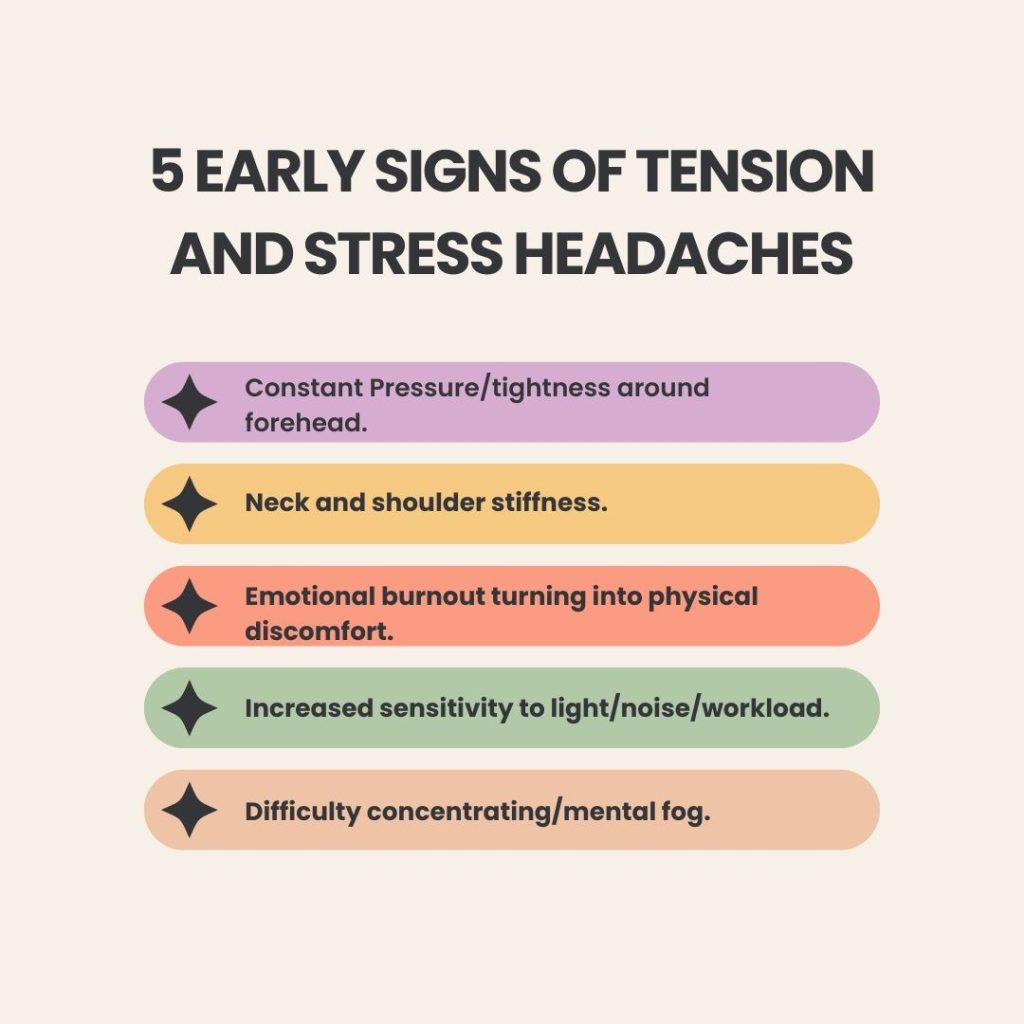
1. A Constant Pressure Or Tightness Around The Forehead.
One of the earliest symptoms I personally observe in myself is a gentle, almost sneaky pressure in my temple regions of the forehead on both sides or behind the eyes. It doesn’t start as “pain”, but like a sensation as if someone has tightly pressed their palms across my forehead.
Young adults coming to my OPD describe it as:
- A tight band around the scalp.
- A weight sitting behind the eyebrows.
- A mild squeezing feeling.
Early on, it may be fleeting, appearing for minutes before disappearing into thin air. But as the stress piles on, the duration of the headache prolongs.
This tightness happens due to the constant activation of the sympathetic nervous system, the same system that fires during anxiety or emotional burnout. Muscles around the scalp, jaw, and neck stiffen as the body unconsciously braces itself.
This quote always stays with me:
“What we refuse to release emotionally, the body holds physically.”
2. Neck And Shoulder Stiffness Before The Headache Even Starts.
Almost every individual I diagnose with Tension and Stress Headaches reports neck stiffness that began days or at times, weeks earlier.
When I personally experience stress buildup, the first region that tightens for me is the Trapezius muscle. This stiffness gradually climbs upwards, eventually triggering the classic Tension and Stress Headaches pattern.
But why does it happen?
- Stress increases muscle tension.
- Poor posture (especially when sitting with emotional heaviness) strains cervical muscles.
- Emotional burdens manifest physically through protective body postures.
If your neck feels stiff every morning or tight during emotionally draining days, consider this an early warning sign. The headache may only be one step behind.
For posture and tension relief, I often recommend exploring progressive muscle relaxation, a technique explained beautifully at AnxietyCanada.
3. Emotional Burnout That Turns Into Physical Discomfort.
There are those days when I can tell a headache is about to show up simply because I feel emotionally exhausted. People often believe headaches start physically, but in reality, mental fatigue is a major precursor.
Emotional exhaustion looks like:
- Losing motivation or the ability to focus on daily activities.
- Being overwhelmed by minor tasks.
- Feeling a lack of energy despite not doing much work physically.
- Feeling “wired but tired”.
As a psychiatrist, I have seen this cycle countless times:
“Stress → Fatigue → Muscle tension → Headache”.
For me, this sign appears subtly-my mind feels foggy, my patience thins, and small noises feel louder than usual. These emotional shifts are warning bells that usually precede physical discomfort.
4. Increased Sensitivity To Light, Noise, Or Workload.
While sensitivity is often associated with migraine, early-stage Tension and Stress Headaches also heighten sensory vulnerability.
You may notice:
- Sounds feel irritating.
- Conversations feel draining.
- Screens feel exhausting.
- Lights feel harsh.
This is not because your senses are malfunctioning, but because your nervous system is overstimulated. When the brain is under stress, its threshold for sensory processing decreases.
I often joke with my patients, “Your brain isn’t angry, it’s overwhelmed”. And overwhelmed minds often express themselves through subtle sensory irritation, way before the pain arrives.
5. Difficulty Concentrating Or Mental Fog Before The Pain Peaks.
Before I get a full-blown headache, I start noticing something I call “cognitive heaviness”. It’s a gentle mental fog-not severe enough to stop my work completely, but enough to make everything slower.
This early sign can manifest as:
- Difficulty finding the right words.
- Troubling focusing on the tasks.
- Slower decision-making.
- Feeling mentally “blurred” or “zoned out”.
This happens because the stress hormone, i.e, cortisol, alters neurotransmitter balance. In simpler terms, your brain becomes fatigued, overloaded, and less efficient, which often precedes the onset of a headache.
A soft reminder I give myself:
“A tired brain creates a tired body”.
Practical Steps To Prevent & Manage Tension and Stress Headaches
Managing Tension and Stress Headaches is as much about prevention as it is about relief. Over the years of hard work and academic pressure, both as a resident psychiatrist and someone who experiences stress headaches personally, I have discovered strategies that work on physical and emotional levels.
1. Notice Your Stress Early:
Conscious awareness is the key. Journaling, reflective breathing, or talking to someone you trust helps release emotional tension before it translates into pain. I often remind myself: “Acknowledging stress doesn’t make you weak; it makes you proactive.”
2. Muscle Relaxation & Posture:
Muscle tension triggers most of the Tension and Stress Headaches. Gentle neck and shoulder massage, warm shower, jaw stretches, along with progressive muscle relaxation, substantially reduce stress. Small adjustments in posture-like keeping screens at eye level or taking regular movement breaks-also help significantly.
3. Sleep, Hydration, Breaks:
Proper sleep routine and good hydration are non-negotiable. Minor disruptions in either of the two can trigger headaches more likely. Short breaks from screens and digital overload also prevent neural overstimulation.
4. Mindfulness & Breathing Exercises:
Do you know that even 5 minutes of focused breathing can calm the nervous system and reduce headache risk? I use this technique almost daily to prevent early tension from escalating.
5. Seek Professional Help:
Persistent headaches may indicate underlying stress or some other medical concern. Consulting a professional, whether for therapy or medical assessment, ensures both mind and body are cared for.
Ultimately, small and consistent actions, including awareness, movement, hydration, and emotional processing, can prevent headaches before they start. Prevention isn’t about perfection; it’s about compassionate attention to yourself.
What Helps In Such A Situation? A Psychiatrist’s Personal & Professional Insight!
When I sense any of these warning signs of Tension and Stress Headache, I pause and perform the deep breathing exercise for a couple of minutes. I stretch my neck, my arms, and at times my legs. I focus on my breathing pattern for quite a while, and drink a glass of water. I then acknowledge my emotional feelings. Sometimes I journal as well, and at other times I simply lie still.
If you want psychology-rich wellbeing content, feel free to explore my platform, YouthTableTalk.
FAQs
1. Are Tension and Stress Headaches the same as Migraine Headaches?
No. Migraines typically involve throbbing pain, nausea, and sensitivity to light or sound. Tension and Stress Headaches feel more like pressure or tightness and do not worsen with physical activity.
2. Can emotional stress alone trigger these headaches?
Yes. Psychological stress is one of the strongest triggers. Even without physical strain, emotional fatigue can lead to muscle tension and stress headaches.
3. How long do Tension and Stress Headaches typically last?
They can last from 30 minutes to several hours. Chronic cases may last up to several days if not treated in time.
4. Do these Tension and Stress Headaches indicate anything serious?
Usually, they are benign and stress-related. However, sudden severe headaches, neurological symptoms, or new onset headaches after the age of 50 require urgent medical/neurological evaluation.
5. What lifestyle modifications help prevent Tension and Stress Headaches?
Regular sleep, adequate hydration, correct posture, stress reduction practices, breaks from screens, and emotional processing (journaling, therapy, relaxation techniques) significantly reduce their frequency.
References
- Mayo Clinic – Tension headache overview
- American Migraine Foundation – Understanding tension headaches
- Cleveland Clinic – Tension-type headaches
- Anxiety & Depression Association of America – Stress and physical symptoms
- WHO – Stress-related health conditions

Dr. Talia Siddiq is a resident psychiatrist in training at Dr. Ruth K.M. Pfau Civil Hospital Karachi, deeply passionate about understanding the human mind and helping people find healing. Beyond her clinical work, she is also a writer who believes that mental health conversations should be easy, relatable, and stigma-free.
She started writing in 2020, turning her reflections and experiences into articles that speak to the struggles many young people silently face—whether it’s self-harm, addictions, relationships, or simply finding direction in life. Over time, her writing has expanded into areas like career guidance and financial independence, because she strongly believes that resilience isn’t just about surviving emotionally—it’s about building a meaningful, balanced life.
For Talia, YouthTableTalk is more than a blog. It’s a safe corner on the internet where young people can pause, reflect, and feel understood. Her goal is not to lecture but to have a conversation—just like a friend who listens, shares, and gently guides you toward growth.
When she isn’t studying psychiatry or writing, you’ll often find her reading, exploring self-growth books, or cooking something new for her family. She brings the same curiosity and compassion to her personal life that she does to her work: always seeking better ways to connect, learn, and inspire.
Through YouthTableTalk, she hopes to remind every reader of one simple truth: you’re not alone, and your story matters.