

My young readers,
As I sit with yet another patient in my Out-Patient Department, fatigued eyes and a trembling voice remind me of how often the Diathesis Stress Model quietly shapes the emotional lives of people around us. This model is not a mere academic theory; it is a living, breathing lens that I use every single day as a Psychiatrist. It helps me make sense of why two people coming from the same family background, facing the same struggles, may respond so differently.
In my previous article, 7 Ways the Diathesis Stress Model Explains Youth Mental Health, I explored the broad patterns I’ve observed. Today, I want to take you even deeper—with real-life examples that illustrate how this framework is applied in practice.
“Every human story is a mosaic of vulnerabilities and victories. The Diathesis Stress Model simply helps us read the mosaic with compassion.”
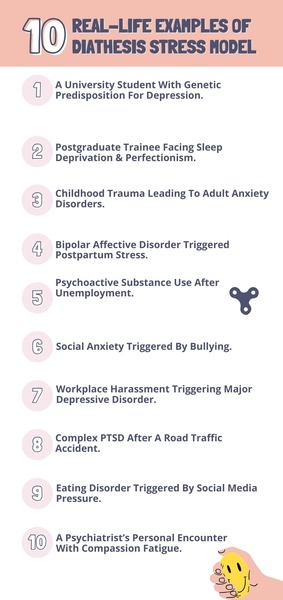
Let’s discuss below the 10 real-life examples drawn from my training experience, composite cases, and personal encounters that show how beautifully (and sometimes painfully) the Diathesis Stress Model manifests in everyday life.
1. A University Student With Genetic Predisposition For Depression.
I once treated a brilliant 19-year-old young lady whose mother and aunt both suffered from Major Depressive Disorder. She stepped into her university with high hopes, but when academic pressures spiked, and she moved away from home, she spiraled into severe low mood, sleep disturbances, and an inability to focus.
Her Diathesis was obvious: A genetic tendency.
The Stressor: Academic pressure and social isolation.
When she was under treatment with me, it was a soft reminder for me that genes don’t actually dictate destiny; they only shape vulnerability. With the right support, she returned to her studies with remarkable resilience.
2. A Postgraduate Trainee Facing Sleep Deprivation and Perfectionism
This example hits very close to home. As a Postgraduate Resident myself, I have experienced how long calls, demanding supervisors, competition among colleagues, the need to excel, and relentless self-expectation can act as potent stressors.
But what was my Diathesis?
Well, I have a temperament deeply inclined towards perfectionism and over-responsibility.
My Stressor?
Chronic sleep deprivation (the silent predator). A good sleep is our body’s requirement as well as my utmost priority since primary school.
The Diathesis Stress Model taught me to recognize how burnout doesn’t mean you are weak. Instead, it’s a signal that my biological and psychological thresholds were super saturated.
Learning this transformed my self-compassion dramatically.
3. Childhood Trauma Leading To Adult Anxiety Disorders.
A young mother once walked into my department with panic attacks so severe that she was afraid to take the bus alone. As we continued to speak, she revealed a history of childhood emotional neglect.
Her Diathesis was early trauma, altering her stress-response system.
Her Stressor was the pressure of caring for two children without any moral or financial support.
When old scars interact with new stress, anxiety can bloom like a bruise from within. Yet healing remains possible and powerful.
4. Bipolar Affective Disorder Triggered By Postpartum Stress.
I have a crisp memory of this, that of a 28-year-old woman with a family history of BPAD who remained without any mental health condition for years until the birth of her first child. The hormonal imbalance, sleep deprivation, and overwhelming demands of motherhood triggered her first episode.
Her Diathesis was the biological susceptibility along with a positive family history.
Her Stressors were postpartum hormonal dysregulation and sleep-wake cycle changes.
This event built my deep interest in perinatal psychiatry and the beauty of timely intervention.
5. Psychoactive Substance Use After Unemployment.
A middle-aged male nurse, who had never had an addiction history, began using Nalbuphine (Opioid) after losing his job. His childhood adversities, impulsive temperament, and genetic vulnerability had always been there, but unemployment became the triggering factor that disrupted the fragile equilibrium.
This example taught me a painful truth:
“Recovery is not just about removing the substance; it’s about stabilizing the environment”.
6. Social Anxiety Triggered By Bullying.
A 14-year-old boy who loved art slowly stopped drawing and painting after experiencing persistent bullying from his school seniors. He was not born anxious. However, his Diathesis was a highly sensitive temperament, which can be a gift at times but not always. The Stressor of peer ridicule led to debilitating social anxiety.
Today, he is flourishing in academics as well as the arts after Therapy. He once said to me:
“Dr Talia, I didn’t realize sensitivity could be a blessing until someone reminded me”.
Luckily, that someone was ME, and moments like this stay with us forever.
7. Workplace Harassment Triggering Major Depressive Disorder.
A 30-year-old woman with mild baseline anxiety developed Major Depressive Disorder after months of workplace harassment. Her Diathesis included anxious personality traits, but she had been coping well until a toxic workplace environment saturated her internal defenses.
I often share resources like this evidence-based guide on workplace mental health, published by the WHO.
It helps patients recognize that their suffering is neither imagined nor their fault.
8. Complex Post-Traumatic Stress Disorder After A Road Traffic Accident.
A young woman in her late twenties with no past psychiatric history developed paranoia, auditory hallucinations, hyperarousal, hyper vigilance, nightmares, avoidance, and panic attacks after a near-death experience of an accident. Her Diathesis was a subtle genetic vulnerability (uncle was a known case of Schizophrenia). The accident served as a severe stressor, unmasking latent psychosis.
This situation reminded me of the fundamental truth:
“Psychosis is not always a lifelong, hopeless condition—sometimes it is context-bound and treatable.”
9. Eating Disorder Triggered By Social Media Pressure.
An 18-year-old young girl possessing perfectionistic traits (a psychological Diathesis) developed Anorexia symptoms (excessive weight loss, limiting dietary intake, inducing vomiting, and using laxatives) after being isolated at home and curating beauty content excessively.
The Stressor in this case was the social comparison amplified by digital spaces. That is why I recommend digital hygiene resources like Psychology Today.
Our youth need protection from invisible stressors that reshape body image and self-worth.
10. A Psychiatrist’s Personal Encounter With Compassion Fatigue.
Finally, one of the most humbling experiences is my own encounter with compassion fatigue. Working in a tertiary care setup means seeing pain and suffering daily. My Diathesis was an emotionally porous personality, one that absorbs others’ pain like a sponge. The stressor was chronic exposure to trauma narratives without adequate emotional boundaries.
The outcome? Emotional exhaustion masquerading as irritability and restlessness.
Writing for my website, YouthTableTalk, became a form of resilience-building for me. For me, it is my home, a haven where I can convert compassion fatigue into meaningful advocacy.
Why Do These Examples Matter?
The Diathesis Stress Model reminds us that:
- No symptom emerges out of the blue.
- No human is “too sensitive” or “too weak”.
- Vulnerabilities combined with stress create drastic outcomes, not the vulnerabilities alone.
And above all:
“What breaks us is not the stress itself, but the silence around it.”
These stories, including the one of my own, validate the lived experiences of millions of people out there. They remind us that healing begins not with judgment, but with compassionate understanding.
FAQs
1. Is it possible to stay mentally healthy despite a strong Diathesis?
Yes. I have witnessed it often in my clinical practice. A person may carry high biological or psychological vulnerability (genetics, early-life trauma, temperament), yet remain mentally stable if their environment is supportive, nurturing, kind, and predictable. This is why some people with a strong family history of mental illness never develop symptoms.
2. Is the Diathesis Stress Model helpful in understanding high-functioning people who suddenly crash?
Most certainly! Especially in today’s world of a perfectionism-driven culture. Many “high-functioning” individuals rely on achievement, discipline, and emotional suppression to cope. When a major stressor hits (burnout, grief, relationship conflict), it shatters the structure they use to stay afloat.
They often say:
“I was holding it together… until I wasn’t.”
This model helps us understand that collapse is not a failure; it’s a threshold being crossed.
3. Can reducing stress alone prevent mental disorders if someone has a strong genetic vulnerability?
In a lot of cases, yes.
Lifestyle modification, healthy relationships, therapy, sleep hygiene, and work-life balance can delay, minimize, or fully prevent illness onset.
This is why early interventions in school, workplace mental health policies, and social support systems are essential.
You cannot alter the genetic makeup, but you can modify exposure.
4. Does the Diathesis Stress Model explain why relapses occur even after successful treatment?
Yes, quite beautifully.
Relapse doesn’t always mean treatment failure.
It often means that new stressors have emerged that surpassed the person’s current coping capacity.
Think of vulnerability as a cup.
Medication, psychotherapy, and healthy coping can reduce how full the cup is. But when life pours more than the cup can hold, symptoms spill over again.
5. According to the Diathesis Stress Model, is stress always harmful?
No. Not necessarily. Moderate stress can build strength. Problems arise when stress is chronic, emotionally draining, or paired with high vulnerability.
References
- American Psychological Association. Diathesis–Stress Model.
- National Institute of Mental Health. Risk Factors for Mental Illness.
- World Health Organization. Mental Health at Work.
- Psychology Today. Social Media and Mental Health.
- Mayo Clinic. Bipolar Disorder — Causes and Risk Factors.

Dr. Talia Siddiq is a resident psychiatrist in training at Dr. Ruth K.M. Pfau Civil Hospital Karachi, deeply passionate about understanding the human mind and helping people find healing. Beyond her clinical work, she is also a writer who believes that mental health conversations should be easy, relatable, and stigma-free.
She started writing in 2020, turning her reflections and experiences into articles that speak to the struggles many young people silently face—whether it’s self-harm, addictions, relationships, or simply finding direction in life. Over time, her writing has expanded into areas like career guidance and financial independence, because she strongly believes that resilience isn’t just about surviving emotionally—it’s about building a meaningful, balanced life.
For Talia, YouthTableTalk is more than a blog. It’s a safe corner on the internet where young people can pause, reflect, and feel understood. Her goal is not to lecture but to have a conversation—just like a friend who listens, shares, and gently guides you toward growth.
When she isn’t studying psychiatry or writing, you’ll often find her reading, exploring self-growth books, or cooking something new for her family. She brings the same curiosity and compassion to her personal life that she does to her work: always seeking better ways to connect, learn, and inspire.
Through YouthTableTalk, she hopes to remind every reader of one simple truth: you’re not alone, and your story matters.