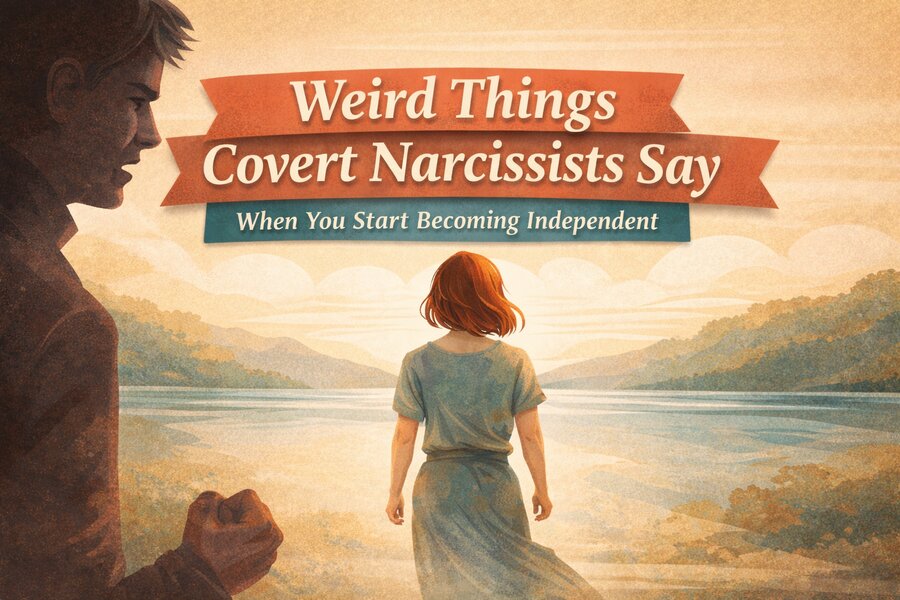
There is a particular moment in Narcissistic abuse that barely gets talked about — the moment when you begin to space away.
Not loudly, not dramatically.
Just quietly, internally, and steadily.
As a Resident Psychiatrist, I have seen this moment unfold during therapy sessions numerous times.
As a survivor of narcissistic abuse, I have lived it in my own mind and body.
Independence does not arrive with fireworks. It comes with clarity. And clarity is deeply unsettling for a Covert Narcissist.
The moment you stop over-explaining yourself.
The moment you stop seeking permission or even validation.
The moment when your nervous system no longer reacts the way it used to.
That is when the language changes.
This article explores weird things Covert Narcissists say, specifically when you start detaching from them — not as random comments, but as psychological alarms indicating loss of control.
“A narcissist does not fear your anger. They fear your indifference.”

Why Does Your Independence Feel Like Abandonment To A Covert Narcissist?
Covert Narcissists do not dominate overtly. They attach. They fuse. They feed off emotional access, self-doubt, and quiet loyalty.
Your independence activates:
- Loss of supply.
- Fear of abandonment.
- Ego fragmentation.
- Narcissistic injury.
So instead of rage, they deploy confusion.
As I often tell my patients:
“Covert Narcissism doesn’t shout. It destabilizes.”
1. “You have changed.. You are not the same person anymore.”
This is often one of the first weird things Covert Narcissists say when you step on the journey towards healing and self.
From a psychological standpoint, this is identity manipulation.
Your growth is considered their loss.
Your boundaries are taken as coldness in attitude.
What they really mean is:
“You are no longer responding to me in ways that benefit me.”
As someone who once internalized this sentence deeply, I now recognize it as a projection of grief for lost control.
“Healing looks like betrayal to those who benefitted from your innocence.”
2. “I miss the older version of you.”
The “old you” was:
- Emotionally compliant.
- Easier to guilt-trip.
- Self-doubting.
- Easily available.
- Empathetic and understanding.
This statement is a nostalgic manipulation — an attempt to pull you back into a version of yourself that abandoned your needs.
From a psychiatric lens, this taps into trauma bonding, where affection is used to override self-trust.
If you want a more psychological and in-depth understanding of trauma bonds, I recommend an excellent resource at Verywell Mind.
3. “I feel like you don’t need me anymore.”
This weird thing Covert Narcissists say sounds quite vulnerable, doesn’t it? Well, let me break it to you — it’s not.
It is a dependency reversal.
Suddenly, you are responsible for soothing their insecurity — right at the moment you are learning to cover your wound with a bandage of self-care.
Covert Narcissists experience independence as emotional abandonment, even when no abandonment has occurred.
“Neediness masquerading as love is still control.”
4. “Ever since you started working/reading/therapy, you have become distant.”
As a Resident Psychiatrist, this sentence makes me pause every time.
Because healthy growth is being pathologized.
Therapy threatens narcissistic systems because:
- It dismantles gaslighting.
- It restores reality testing.
- It validates emotional truth.
This is why many Covert Narcissists subtly discredit mental health support.
For individuals interested in how narcissistic traits are clinically understood, visit the Cleveland Clinic for a balanced overview.
5. “I just don’t know where I stand with you anymore.”
This weird thing Covert Narcissists say is to re-ignite anxiety.
When you become independent, predictability disappears.
And unpredictability terrifies a narcissistic structure built on control.
Instead of asking where they stand, they pull you into explaining, reassuring, and anchoring.
“Your clarity threatens those who thrived on your confusion.”
6. “You are acting as if you are superior to me.”
This is defensive devaluation.
Confidence is misread as arrogance.
Boundaries are reframed as ego.
Clinically, this reflects narcissistic envy — your self-containment highlights their emotional emptiness.
As someone who once shrank myself to avoid his accusation, I now recognize it as a signal of growth.
7. “I guess you don’t care about us anymore.”
This is one of the most weird things Covert Narcissists say because it attacks your values.
Independence does not mean lack of care.
It means self-respect.
This statement is a pure emotional blackmail, activating guilt to override autonomy.
“Choosing yourself is not abandonment.
It is return.”
The Psychological Shift They Sense (But Can’t Name)
When you start becoming independent:
- You stop chasing emotional repair.
- You tolerate silence.
- You no longer over-explain.
- Your nervous system stabilizes.
From a psychiatric lens, this represents secure attachment emerging out of trauma — and that is profoundly destabilizing to someone dependent on emotional chaos.
If you would like to explore attachment healing further, I have discussed related themes on Youth Table Talk, where mental health meets lived experience.
The Moment You Stop Explaining Is The Moment They Begin To Tremble.
Covert Narcissists rely on your internal noise.
When you stop defending:
- Their guilty games lose power.
- Their scripts fail.
- Their confusion reflects back at them.
And so the statements escalate.
Not because you are mean or toxic.
But because you are setting yourself free.
A Gentle Reminder From Someone Who Has Been There.
I say this both as a Resident Psychiatrist as well as a survivor of narcissistic abuse:
“If your independence feels like cruelty to someone,
ask yourself who benefited from your self-abandonment.”
You are not cold.
You are not selfish.
You are not unloving.
You are regulated
And that changes everything.
Independence Is Not The End — It Is The Beginning To A Beautiful Journey Of Self-Love.
There comes a quiet moment in healing where you realize you are no longer trying to be understood by someone committed to misunderstanding you.
This is independence.
Not loud.
Not performative.
But deeply rooted.
The weird things Covert Narcissists say when you start becoming independent are not signs that you are doing something wrong — they are evidence that you are finally doing something right.
And if no one has told you this yet:
You are allowed to outgrow places that once felt like home.
Independence is not the absence of love; it is the presence of self. When you stop shrinking to be loved or understood, something sacred happens — you begin to belong to yourself again. And that belonging is not defiance, not cruelty, not abandonment. It is the most honest form of emotional maturity there is.
FAQs
1. Why do Covert Narcissists react negatively to independence?
Because independence disrupts their access to emotional regulation and control.
2. Are these statements always intentional?
Not always consciously, but they are psychologically patterned.
3. Can independence make a Covert Narcissist escalate their behavior?
Absolutely. Many individuals report an escalation phase — more guilt-tripping, victim narratives, or triangulation — when emotional influence begins to weaken.
4. Is emotional withdrawal a common response when control is lost?
Yes. Emotional withdrawal is a defensive maneuver. When manipulation no longer works, Covert Narcissists may withhold affection to regain leverage or provoke guilt.
5. How do I know if my independence is healthy or avoidant?
Healthy independence feels grounded, calm, and internally guiding. Avoidance feels emotionally numbing or fear-driven. Therapy can help differentiate the two.
References

Dr. Talia Siddiq is a resident psychiatrist in training at Dr. Ruth K.M. Pfau Civil Hospital Karachi, deeply passionate about understanding the human mind and helping people find healing. Beyond her clinical work, she is also a writer who believes that mental health conversations should be easy, relatable, and stigma-free.
She started writing in 2020, turning her reflections and experiences into articles that speak to the struggles many young people silently face—whether it’s self-harm, addictions, relationships, or simply finding direction in life. Over time, her writing has expanded into areas like career guidance and financial independence, because she strongly believes that resilience isn’t just about surviving emotionally—it’s about building a meaningful, balanced life.
For Talia, YouthTableTalk is more than a blog. It’s a safe corner on the internet where young people can pause, reflect, and feel understood. Her goal is not to lecture but to have a conversation—just like a friend who listens, shares, and gently guides you toward growth.
When she isn’t studying psychiatry or writing, you’ll often find her reading, exploring self-growth books, or cooking something new for her family. She brings the same curiosity and compassion to her personal life that she does to her work: always seeking better ways to connect, learn, and inspire.
Through YouthTableTalk, she hopes to remind every reader of one simple truth: you’re not alone, and your story matters.