A Psychiatrist’s Reflection From Both Sides Of The Wound
Dear readers,
Being a Resident Psychiatrist and a narcissistic abuse survivor, I have sat on both sides of the room.
On one side, I am a mental health professional — trained to observe patterns, decode defense mechanisms, and understand trauma responses with clinical clarity. On the other side, I am someone who once lived inside the quiet devastation caused by weird things Covert Narcissists say — sentences that never sounded abusive, yet slowly poisoned my sense of self.
Covert Narcissistic abuse doesn’t yell. It whispers. It disguises itself as concern, intellect, spirituality, or wounded innocence.
And with the passage of time, those whispers lodge themselves into the psyche, shaping how the brain processes safety, attachment, and self-worth.
“Not all wounds bleed. Some rewrite how the mind speaks to itself.”
Today, my words will not only provide you with professional insight but also personal truth.
Understanding Weird Things Covert Narcissists Say: Why Language Matters?
Words are not neutral in psychologically unstable relationships. Language becomes a tool — not to communicate, but to destabilize.
Covert Narcissists often rely on linguistic ambiguity, emotional inversion, and plausible deniability. Phrases such as:
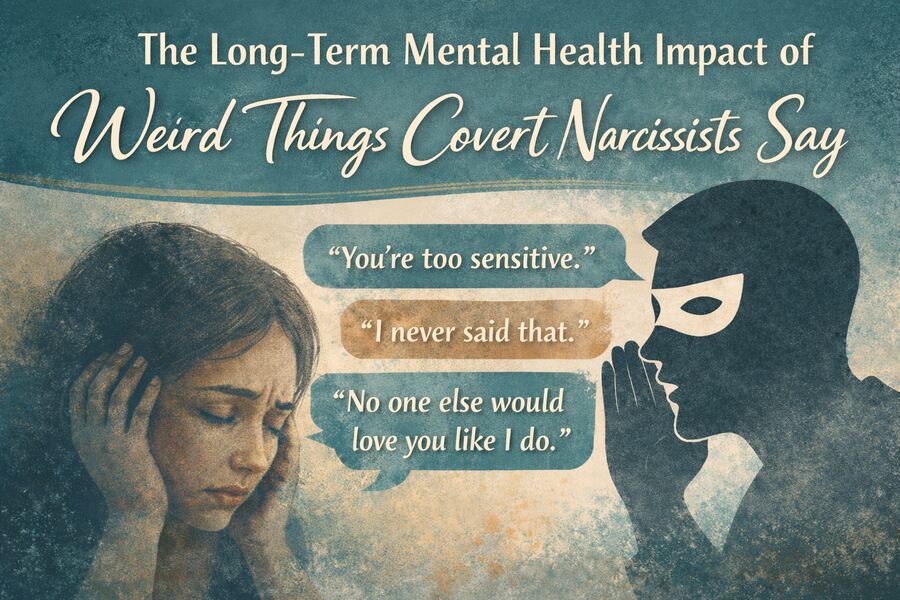
- “You are too sensitive.”
- “I never said that — you misunderstood.”
- “I am the only one standing by your side and the one who truly loves you,”
These are not casual remarks. They are psychological interventions — designed to shift reality subtly enough that the victim doubts their own perception.
From a psychiatric standpoint, this repeated distortion activates chronic stress pathways, particularly the HPA axis, keeping the brain in a prolonged state of threat anticipation.
Gaslighting And The Erosion Of Cognitive Trust
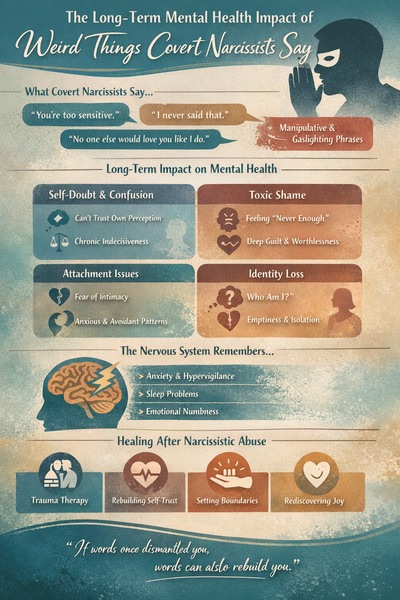
One of the most devastating long-term effects I see — both clinically and personally — is epistemic self-doubt: the inability to trust one’s own mind.
When someone repeatedly hears weird things Covert Narcissists say, the brain learns a dangerous lesson:
“Your perception is unsafe. Outsource reality.”
Over time, this results in:
- Anxiety disorders.
- Obsessive rumination.
- Heightened suggestibility.
- Chronic indecisiveness.
- Depersonalization symptoms.
Research from the American Psychological Association shows that prolonged gaslighting can mimic the cognitive confusion seen in trauma-related disorders, particularly complex PTSD.
Emotional Invalidation & The Birth Of Toxic Shame
Covert Narcissists rarely attack directly. Instead, they invalidate the emotion itself.
“Why are you making such a big deal out of this?”
“Other people wouldn’t react this way.”
As the years pass, this creates toxic shame — a belief not that something went wrong, but that you are inherently flawed.
Clinically, this manifests as:
- Shame-based identity.
- Social withdrawal.
- Perfectionism or loss of self-identity.
- Persistent guilt.
- Lack of confidence.
As Judith Herman describes in Trauma and Recovery, emotional invalidation disrupts the basic human need to feel mirrored and understood, impairing identity cohesion over time.
Attachment Injuries That Last Long After The Relationship Ends
One of the most enduring psychiatric consequences of Covert Narcissistic abuse is attachment dysregulation.
The push and pull dynamic — idealization followed by withdrawal — rewires the nervous system to associate love with anxiety.
“The person who hurts you also becomes the person your brain craves.”
Long-term outcomes are as follows:
- Anxious or fearful-avoidant attachment styles.
- Hypervigilance in intimacy.
- Confusing calm with boredom.
- Difficulty trusting emotionally safe people.
I have written more deeply about attachment wounds and relationship trauma on Youth Table Talk, in case you wish to explore — because healing requires language for what once felt unspeakable.
Identity Fragmentation: When You Forget Who You Were
Perhaps the most painful impact of the weird things Covert Narcissists say is identity erosion.
Slowly, you stop asking:
- What do I feel?
- What do I want?
- What matters to me?
And start asking:
- How do I avoid conflict?
- How do I stay acceptable?
This adaptive self-abandonment may look functional, but internally it creates anhedonia, emptiness, and existential distress — often misdiagnosed as Depression without addressing the relational root.
“I didn’t lose myself suddenly. I misplaced myself sentence by sentence.”
The Nervous System Remembers What The Mind Tries To Forget
Even after parting ways, many survivors experience:
- Emotional detachment or numbing.
- Sleep disturbances.
- Startle responses.
- Somatic anxiety.
This is not weakness- this is your neurobiological memory in action.
According to trauma neuroscience research published in The National Institute of Mental Health, emotionally unpredictable environments condition the Amygdala to remain hyperactive long after the danger ends.
Your body remembers what your conscious mind tried to rationalize away.
Why Healing Is Often Delayed — And Why Is It Not Your Fault?
Covert Narcissistic abuse delays recognition. Many survivors don’t label the experience as abuse until years later.
Why is that!?
- There were no bruises or scar marks.
- The abuser was “nice”.
- You were blamed for reacting.
As a Resident Psychiatrist, I want to say this clearly:
Delayed insight is not denial—it is survival.
Reclaiming Mental Health After Covert Narcissistic Abuse
Recovery is not about becoming “stronger”.
It is about becoming real again.
Clinically effective steps include:
- Attachment-based work.
- Trauma-informed psychotherapy.
- Grief processing for the self you lost.
- Somatic regulation.
- Rebuilding epistemic trust.
Most importantly, healing requires compassion — not urgency.
When Your Inner Voice Starts Sounding Like Them
One of the most haunting long-term effects of weird things Covert Narcissists say is this: eventually, the voice follows you even when they are gone.
I have seen this repeatedly in my patients — and painfully, in myself. Long after the relationship ends, the mind begins to replicate the same invalidating phrases internally. You are overreacting. You are being difficult. This is why people leave. This is not a coincidence; it is conditioning.
From a psychiatric lens, this represents internalized perpetrator dynamics, a well-documented trauma phenomenon where the brain adopts the abuser’s narrative to maintain psychological coherence. The cost is steep. Self-criticism becomes relentless, self-compassion feels unsafe, and rest feels undeserved.
“Abuse doesn’t end when the relationship ends. It ends when the inner dialogue changes.”
Healing begins when we learn to gently interrupt that voice — and replace it with one grounded in reality, safety, and self-respect.
Healing Takeaway
I often tell my patients — and remind myself:
“If words once dismantled you, words can also rebuild you.”
The long-term mental health impact of the weird things Covert Narcissists say is real, measurable, and profound. But so is recovery.
You are not broken.
You were trained to disappear — and now you are learning how to return.
And that, quietly, is one of the bravest psychological acts a human being can make.
FAQs
1. Can Covert Narcissistic Abuse change Personality Traits?
It doesn’t change who you are, but it can suppress authenticity, increase people-pleasing, and heighten anxiety-based traits as survival strategies.
2. Is it normal to miss someone who emotionally harmed me?
Yes. Trauma bonding can coexist with insight, creating grief for the connection even when you understand the harm.
3. Why do safe relationships feel unfamiliar or uncomfortable afterward?
Because your nervous system was trained to associate intensity with connection and calm with emotional distance.
4. Does awareness alone lead to healing?
Awareness is essential, but healing requires nervous-system regulation, emotional processing, and relational repair.
5. How long does recovery from Covert Narcissistic abuse take?
There is no timeline. Healing unfolds in layers and often accelerates once self-trust is restored.
References

Dr. Talia Siddiq is a resident psychiatrist in training at Dr. Ruth K.M. Pfau Civil Hospital Karachi, deeply passionate about understanding the human mind and helping people find healing. Beyond her clinical work, she is also a writer who believes that mental health conversations should be easy, relatable, and stigma-free.
She started writing in 2020, turning her reflections and experiences into articles that speak to the struggles many young people silently face—whether it’s self-harm, addictions, relationships, or simply finding direction in life. Over time, her writing has expanded into areas like career guidance and financial independence, because she strongly believes that resilience isn’t just about surviving emotionally—it’s about building a meaningful, balanced life.
For Talia, YouthTableTalk is more than a blog. It’s a safe corner on the internet where young people can pause, reflect, and feel understood. Her goal is not to lecture but to have a conversation—just like a friend who listens, shares, and gently guides you toward growth.
When she isn’t studying psychiatry or writing, you’ll often find her reading, exploring self-growth books, or cooking something new for her family. She brings the same curiosity and compassion to her personal life that she does to her work: always seeking better ways to connect, learn, and inspire.
Through YouthTableTalk, she hopes to remind every reader of one simple truth: you’re not alone, and your story matters.