
By a Resident Psychiatrist & a Survivor
When Words Become Wounds
I still remember the first time a sentence made me doubt my own sanity.
It wasn’t shouted.
It wasn’t cruel in the obvious sense.
It was said softly — almost gently.
And yet, it hollowed me out.
As a Resident Psychiatrist, I have spent years studying personality dynamics, trauma responses, and emotional abuse. As a survivor of narcissistic abuse myself, I have lived these bitter statements in my bones. What unsettles me most is not the overt cruelty of narcissism but the quiet, disorienting language of the Covert Narcissists. The phrases that don’t sound abusive, yet leave you anxious, confused, and smaller than you were before.
Today’s write-up is about breaking free from the influence of weird things Covert Narcissists say, not just intellectually, but emotionally and neurologically. It is about reclaiming your inner compass after it has been repeatedly tampered with.
“The most dangerous manipulation is the one that convinces you it never happened.”
What Makes Covert Narcissist Language So Devastating?
Unlike Overt Narcissists, Covert Narcissists seldom dominate conversations with grandiosity. Instead, they weaponize subtlety. Their language is wrapped in humanity, concern, or victimhood — making it difficult to identify, let alone challenge.
Clinically speaking, this form of communication functions through:
- Intermittent reinforcement.
- Gaslighting.
- Cognitive dissonance.
- Attachment injury.
What makes weird things Covert Narcissists say so detrimental is not just what is said, but how it destabilizes your internal narrative.
“I’m not attacking you, I’m just being honest.”
“You’re too sensitive—I worry about how you’ll survive in the real world.”
Each sentence carries plausible deniability while quietly eroding self-trust.
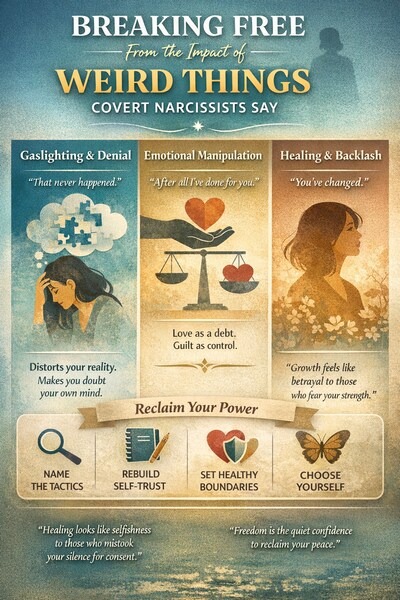
“I never said that”: The Silent Architecture Of Gaslighting.
One of the most psychologically corrosive statements I hear in both my OPD and my own memories is:
“That never happened”.
Gaslighting works by forcing the victim to outsource their reality. Over time, the brain adapts by becoming hypervigilant, second-guessing perceptions, and scanning constantly for emotional security.
From a neurobiological perspective, this keeps the Amygdala activated and suppresses the prefrontal cortex’s activity. Therefore, the survivors of narcissistic abuse often say, “My brain feels clouded” or “I am unable to recognize myself anymore”.
If this pattern resonates with you, please know that you are not weak. You are responding normally to prolonged psychological threats.
For further learning on gaslighting dynamics, I often recommend an evidence-based overview on Psychology Today.
“After everything I have done for you”: Love Serving As A Ledger.
Another well-known hallmark of weird things Covert Narcissists say is emotional accounting.
“I have sacrificed so much for you.”
“No one else would have stayed with a difficult person like you.”
Statements like these covertly transform relationships into moral debts. Love is no longer mutual. It becomes conditional, transactional, and heavy.
From a psychological standpoint, this creates learned guilt, where the survivor feels perpetually indebted and undeserving of autonomy. Over time, guilt replaces joy, and compliance masquerades as a sense of peace.
“When love feels like something you must repay, it is no longer love—it is control.”
Why Attachment Trap: Why Breaking Feels Impossible?
As a Resident Psychiatrist, I can’t discuss recovery without addressing the role of Attachment Theory in it.
Many survivors of Covert Narcissism have anxious or trauma-bonded attachment styles. The narcissist alternates between emotional closeness and withdrawal, creating a powerful dopamine-cortisol loop.
This is why statements like:
“I’m the only one who really understands you.”
Feel comforting — and scary — at the same time.
Your nervous system becomes attached not to safety, but to the relief from distress.
Feel free to reach out to us at Youth Table Talk for a broader mental health-centered discussion on relationship trauma and emotional abuse.
“You have changed”: When Moving-on & Healing Is Framed As Betrayal.
“You have changed.
“You don’t love me anymore”.
Few sentences sound as neutral and feel as damaging as these. It is often delivered with a sigh, a soft shake of the head, or a broken tone that suggests loss rather than accusation. Yet in the context of Covert Narcissistic dynamics, these statements are rarely an observation. Instead, they are an indictment.
When a Covert Narcissist says, “You have changed”, what they are truly mourning is not the relationship but the loss of access.
Because I am trained to unveil Narcissism, I know this reaction through the lens of threatened psychological equilibrium. Covert Narcissists rely on familiar relational roles to stabilize their fragile self-concept. When you were accommodating, self-doubting, over-explaining, or emotionally over-functioning, the system was working perfectly fine for them. When you chose to part ways, the system was disrupted.
From a survivor of narcissistic abuse perspective, this sentence lands differently. It often activates a deep, almost reflexive guilt. You begin to scan yourself for evidence:
“Am I colder? Less kind? More selfish?”
And just like that, moving on is reframed as moral failure.
“They call it change because they cannot call it autonomy.”
Clinically, what you are experiencing here is identity dissonance. Healing requires the development of boundaries, discernment, and self-prioritization — traits that were previously discouraged or punished in the relationship. When you refuse to absorb blame automatically, tolerate ambiguity, or shrink to preserve harmony, you violate the unspoken contract of the trauma bond.
Covert Narcissists often experience this as abandonment rather than accountability. Instead of asking, “Why do I feel threatened by your growth?” they externalize the discomfort:
- “Therapy has changed you”.
- “You are becoming so rude and arrogant”.
- “You were an easier person to talk to”.
What they actually mean is: “You no longer cater to my emotional needs”.
“Healing looks like betrayal only to those who mistook your survival responses for loyalty.”
This is also the stage where many survivors are most vulnerable to relapse — not because they want the relationship back, but because they want relief from guilt. The old version of you was praised for being endlessly understanding. The healed version of you is criticized for being discerning.
Let me say this clearly, both as a mental health professional and as someone who has lived it:
You are not cruel for becoming clearer.
You are not selfish for choosing emotional safety.
And you are not bound to remain recognizable to those who benefited from your pain.
Reclaiming Your Inner Authority
Breaking free from the impact of weird things Covert Narcissists say requires more than insight — it requires reinventing yourself.
From a personal and professional point of view, recovery involves:
1. Naming the pattern
Language loses power when it is accurately labeled.
2. Rebuilding Self-Trust
Trauma-informed therapy, somatic awareness, meditation, and journaling help restore inner authority.
3. Learning Emotional Literacy
Not every discomfort is a danger. Not every guilt signal is true.
4. Practicing Boundaries Without Explanation
You don’t need to convince someone who is invested in misunderstanding you.
You can refer to the American Psychiatric Association for the clinical and diagnostic framework on narcissistic personality traits.
The Grief No One Talks About
One of the most painful parts of recovery is grieving the person you thought they were — and the version of yourself that believed in them.
The grief is real. It is complex. And it deserves compassion.
“You are not mourning the relationship—you are mourning the illusion that kept you alive.”
Coming Home To Yourself
Breaking free from the impact of weird things Covert Narcissist say is not about winning arguments or proving abuse. It is about retuning to yourself — to your instincts, your clarity, and your emotional sovereignty.
As a Survivor and a Resident Psychiatrist, I want you to keep in mind:
You were never too sensitive or overreacting.
You were perceptive in an environment that demanded blindness.
And the fact that you are questioning, learning, discovering, and healing means the manipulation no longer owns you.
“Freedom begins the moment you stop negotiating with a voice that was never meant to guide you.”
You are allowed to trust yourself again. Above all, you deserve a love that is nurturing, emotionally secure, and compassionate. You need an environment where you can thrive rather than burn down to ashes.
FAQs
1. Why do Covert Narcissists often sound caring while being emotionally harmful?
Because their communication is rooted in plausible deniability. Concern, softness, or humility act as camouflage, allowing emotional control without overt aggression.
2. Can someone unintentionally adopt narcissistic language after long-term exposure?
Yes. Survivors may temporarily mirror invalidating phrases due to trauma conditioning. Awareness and psychotherapy usually reverse this pattern with time.
3. Why do I feel guilty even after identifying the manipulation?
Guilt is often a conditioned response, not a moral signal. In narcissistic dynamics, guilt is trained through emotional withdrawal and blame-shifting.
4. How is Covert Narcissistic abuse different from healthy conflict?
Healthy conflict seeks resolution and mutual understanding. Covert Narcissistic communication seeks dominance, emotional advantage, or self-protection.
5. Is it possible to heal without completely cutting contact?
Yes. It is possible, but it requires strong boundaries, emotional detachment, and often psychological support. For some people, less contact works better than no contact.