
There is a particular kind of silence that follows emotional harm inflicted by words that sound harmless. As a Resident Psychiatrist, I have sat across countless patients who could not name what was wrong — only that something inside them felt eroded, diminished, strangely guilty. And as someone who has survived narcissistic abuse myself, I recognize that silence intimately.
Covert Narcissism does not announce itself loudly. It whispers. It disguises itself as vulnerability, morality, sensitivity, and self-sacrifice. The weird things Covert Narcissists say often arrive wrapped in confusion rather than hostility, and that is precisely why they penetrate so deeply.
Attachment Theory provides us with a powerful lens to decode these statements, not to excuse them, but to understand the psychological architecture beneath them. When we know why these words are spoken, we begin to loosen their grip on our nervous system.
“The most dangerous manipulations are the ones that masquerade as emotional honesty.”
Why Attachment Theory Matters Here?
Attachment Theory, originally given by John Bowlby, teaches us that our earliest relationship experiences shape how we seek closeness, regulate emotions, and manage perceived abandonment. In Covert Narcissism, attachment wounds are significant but carefully concealed.
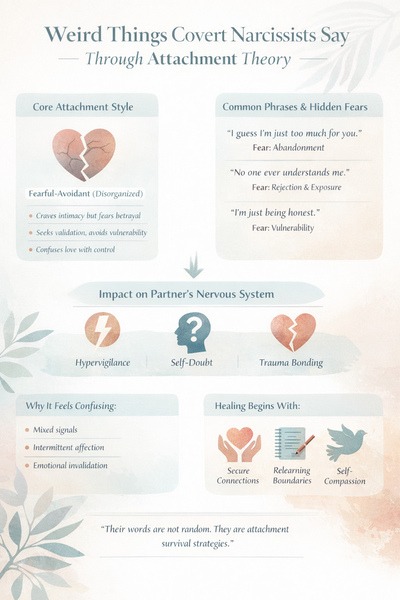
Most Covert Narcissists operate from a disorganized or fearful-avoidant attachment style:
- They crave to be seen but panic when truly known.
- They desire intimacy but fear exposure.
- They seek reassurance but resent dependence.
Their language reflects this inner contradiction.
When clients ask me, “Why do their words feel so confusing?” My answer is pretty straightforward: “Because the speaker themselves is psychologically split”.
Why Do Covert Narcissists Speak The Way They Do?
When I explain Covert Narcissism to patients or reflect on it as someone who has lived through it, I often say this:
“Their words are not random. They are survival strategies learned in unsafe emotional environments.”
Attachment Theory allows us to move beyond labeling behavior as merely “toxic” and instead understand the relational nervous system that produces it.
The Core Attachment Wound
Most Covert Narcissists do not fit neatly into a typical avoidant or anxious attachment style. Clinically, they cluster around fearful-avoidant (disorganized) attachment — the most internally conflicted style.
This attachment pattern forms when:
- Love is paired with criticism, withdrawal, or conditional approval.
- Caregivers are emotionally inconsistent, intrusive, shaming, or unpredictable.
- The child learns that closeness is both desired and dangerous.
The result is an adult who:
- Fears exposure and dependence.
- Craves emotional intimacy.
- Uses indirect language to regulate closeness without risking rejection.
Their speech becomes a regulation tool.
Language As Attachment Regulation
In securely attached individuals, language is used to:
- Deepen mutual understanding.
- Repair damages.
- Clarify needs.
In Covert Narcissism, language is used to:
- Elicit reassurance without vulnerability.
- Avoid accountability while preserving connection.
- Clarify needs.
This is why the weird things Covert Narcissists say feel so destabilizing. They are not meant to resolve tension — they are intended to manage attachment anxiety.
Attachment Systems Behind Specific Statements
1. Hyperactivation: Fishing For Reassurance
Statements like:
“I guess I’m just too much for you.”
This reflects attachment hyperactivation — the nervous system is flooded with abandonment fear.
Instead of saying, “I feel scared of losing you”, the Covert Narcissist externalizes distress through guilt-inducing language.
Why?
Because direct emotional need once led to rejection or humiliation.
2. Deactivation: Emotional Withdrawal Disguised As Honesty
Statements like:
“I am just being honest.”
This reflects deactivation strategies, where emotional responsibility is minimized to restore a sense of control.
In early attachment, emotional engagement may have felt overwhelming or unsafe. As adults, Covert Narcissists retreat into “truth” to avoid emotional attunement.
“Truth becomes armor when vulnerability feels dangerous.”
3. Protest Behavior: Suffering As Communication
Statements like:
“I never ask for anything.”
This is classic protest behavior — indirect attempts to elicit care without explicitly revealing a need.
The attachment system is saying:
“I need you — but I don’t believe you will respond kindly if I ask.”
Over time, partners internalize chronic guilt and emotional debt.
Why Do These Weird Things Covert Narcissists Say Create Trauma Bonds?
From an attachment neuroscience perspective, the danger lies in intermittent emotional reinforcement.
The Covert Narcissist alternates between:
- Emotional closeness and moral superiority.
- Idealization and subtle invalidation.
- Vulnerability and withdrawal.
This unpredictability dysregulates:
- Dopaminergic reward circuitry.
- The Amygdala (threat detection).
- The attachment system (safety seeking).
The partner becomes emotionally preoccupied — not because they are weak, but because their attachment system is constantly trying to restore safety.
“Confusion is not chemistry. It is an attachment injury.”
The Nervous System Cost Of Weird Things Covert Narcissists Say
What makes these weird things Covert Narcissists say so destabilizing is not their content — it is their inconsistency. Your nervous system is unable to predict whether closeness will bring warmth or withdrawal.
This creates:
- Emotional self-doubt.
- Attachment anxiety in otherwise secure individuals.
- Hypervigilance.
I have managed individuals who stepped into Psychotherapy believing they were “too needy, or “emotionally broken”, only to discover they were responding naturally to relational unpredictability.
If you resonate with this pattern of abuse, you can always refer to reflective platforms such as Youth Table Talk to further explore these dynamics in accessible, compassionate ways.
Why Do Survivors Blame Themselves?
As a Resident Psychiatrist, I see this repeatedly:
Survivors leave believing they were the troublemaker.
This happens for the following reasons:
- The Covert Narcissist’s language never sounds overtly abusive.
- Responsibility is subtly shifted.
- Emotional reality is reframed as oversensitivity.
Attachment Theory explains this beautifully:
When relationship safety is threatened, the brain prefers self-blame over abandonment.
Self-blame preserves the illusion of control.
Why Is Leaving So Psychologically Hard?
From an attachment standpoint, leaving a Covert Narcissistic relationship feels like abandoning a wounded child — even when that “child” is a mature adult causing harm.
The intermittent reinforcement, emotional vulnerability, and pseudo-intimacy create a powerful trauma bond.
“You don’t miss the person. You miss the version of yourself who believed true love could heal them.”
Healing begins when we understand that compassion does not require self-erasure.
Reclaiming Your Attachment Security
One of the quiet tragedies I witness — both in my Outpatient Department and in my own life history — is how survivors of Covert Narcissistic relationships begin to distrust their capacity for connection. They don’t say, “I was harmed.” They say, “Something must be wrong with me”.
Attachment Theory tells us otherwise.
Your distress was not a flaw in character or emotional strength. It was your attachment system doing exactly what it was designed to do: search for safety in an unpredictable emotional environment.
In relationships shaped by Covert Narcissism, security erodes slowly. There is no single rupture — only a series of subtle misattunements. Needs are met inconsistently. Vulnerability is welcomed one moment and quietly punished the next. Over time, your nervous system adapts by becoming vigilant, self-correcting, and overly empathic.
Reclaiming attachment security doesn’t mean becoming emotionally armored. It means learning to distinguish intimacy from intensity.
Secure attachment is not dramatic. It doesn’t require emotional labor to sustain itself. It allows needs to be spoken without performance and boundaries to exist without guilt. For many survivors, this calmness initially feels unfamiliar, even boring, because trauma trained the nervous system to associate love with urgency.
As a Resident Psychiatrist, I often tell my patients: healing begins when you stop asking, “How do I make this relationship work?” And start asking, “How does my body feel in this connection?”
Attachment security is rebuilt through experiences, not insight alone:
- Conflicts that lead to repair instead of withdrawal.
- Relationships where words and actions align.
- Emotional responses that are met with curiosity rather than correction.
Perhaps, most importantly, reclaiming security requires releasing the unconscious belief that understanding someone else’s wounds is a prerequisite for being loved.
“You don’t need to earn safety by being endlessly patient, insightful, or forgiving.”
Your needs don’t make you excessive. They make you human.
FAQs
1. Which attachment style is most commonly associated with Covert Narcissism?
Covert Narcissism is most commonly associated with Disorganized or Fearful-Avoidant attachment style, where closeness is deeply desired but also feared.
2. What’s the reason behind the Covert Narcissist’s indirect communication?
Indirect communication develops when early attachment makes direct emotional expression feel unsafe, so emotions are communicated indirectly through guilt, withdrawal, or self-victimization.
3. Is attachment insecurity the prime reason behind narcissistic behavior?
Attachment insecurity contributes to narcissistic traits but does not excuse harmful behavior. Insecure attachment can shape hurtful communication, but it does not excuse emotional manipulation, gaslighting, and playing blame games.
4. Why is the relationship with a Covert Narcissist so addictive?
Inconsistent emotional availability activates trauma bonding, keeping the attachment system locked in a cycle of hope and distress.
5. Can attachment security be restored after Covert Narcissistic abuse?
Yes, attachment security can be rebuilt through consistent, emotionally safe relationships and trauma-informed therapy.
References
- Mikulincer & Shaver — Attachment Theory and Psychopathology
- Meta-Analysis: Attachment Insecurity and Pathological Narcissism
- Study on Attachment Styles, Vulnerable Narcissism, and Emotion Dysregulation
- Attachment Styles, Vulnerable Narcissism, and Social Support
- Narcissism, Attachment, and Relationship Processes
- Study Linking Narcissism and Insecure Attachment in University Students
- Attachment Theory: The Cambridge Handbook