
I want to begin with something bitter-especially coming from a Psychiatrist.
Some of the most psychologically dangerous statements I have encountered in narcissistic abuse sound intelligent, ethical, and even self-aware.
They don’t feel like manipulation at the moment.
They feel like depth.
As someone trained to analyze language clinically as well as someone who has survived narcissistic abuse, I have learned this the hard way:
Covert Narcissism does not announce itself through cruelty. It announces itself through plausibility.
Along with you guys, I aim to explore the weird things Covert Narcissists say. They are not the recycled quotes taken from Pinterest, but subtle linguistic patterns that quietly dismantle your sense of self while appearing reasonable, reflective, or even emotionally sorted.
“The most dangerous manipulation doesn’t sound wrong — it sounds wise.”
Why Is Covert Narcissistic Language So Hard To Detect?
Covert Narcissists don’t dominate conversations; they curate them.
They use:
- Strategic restraint
- Moral positioning
- Selective vulnerability
- Intellectualized emotion
Clinically, this aligns with vulnerable narcissism, where self-esteem is maintained not through grandiosity but through quiet superiority and relational control.
Their language rarely shocks you.
It wears you down.
The red flags in Covert Narcissistic conversation are beautifully concealed and therefore easily missed. To identify these red flags, I invite you to walk through this piece of writing with me so that you can spot the Covert Narcissist’s play before it takes a toll on you and destroys your mental health entirely.
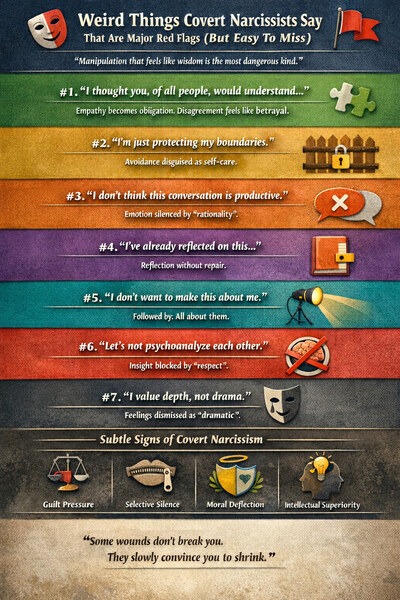
1. “I thought of all people, at least you would understand”.
This sentence is not about understanding.
It is about exclusivity-based pressure.
The implication is subtle:
- You are “special” and therefore obligated.
- Disagreement equals betrayal.
- Your empathy is now a liability.
“When understanding becomes an expectation, it stops being compassionate and becomes control.”
With the passage of time, you stop expressing discomfort, not because you agree, but because you don’t want to lose your perceived status as the one who understands.
This is a uniquely covert manipulation tactic rarely named outright.
2. “I am just being extra cautious with my boundaries”.
Boundaries are healthy except when they are weaponized.
In Covert Narcissism, this phrase often appears when:
- Emotional reciprocity is expected.
- Accountability is requested.
- Repair is needed.
What it really means:
“I won’t engage, but I will sound psychologically correct while refusing to do so”.
Clinically, this indicates avoidant defensiveness disguised in therapeutic language.
“Not all boundaries protect — some isolate accountability.”
This is one of the most insidious, weird things Covert Narcissists say because it borrows legitimacy from mental health discourse.
3. “I don’t think this conversation is productive”.
Productive for whom?
This sentence shuts down dialogue without resolving the issue, positioning the speaker as rational and the other as emotionally inefficient.
The hidden function:
- Premature termination of conflict.
- Emotional invalidation without aggression.
- Subtle superiority through “reasonableness”.
In survivors, this often creates conversational paralysis-the feeling that no matter how calmly you speak, resolution is unreachable.
“When ‘productivity’ replaces empathy, connection quietly dies.”
4. “I have already reflected on this”.
This statement signals closure, as in no more discussion on this matter, whether or not the repair has occurred.
It communicates:
- The internal process is complete.
- External impact is not relevant by any means.
- Further discussion is pointless.
From a clinical standpoint, this is a self-referential resolution where internal reflection replaces relational accountability.
You are not invited into the reflection.
You are informed that it has already happened.
5. “I don’t want to make this about me”.
Listen carefully to what follows this sentence.
Often, it becomes entirely about them.
This phrase functions as:
- Emotional camouflage.
- Guilt inoculation.
- Preemptive moral positioning.
“When someone announces humility, they are often preparing to bypass it.”
You leave the conversation, comforting the very person who caused the damage, without even naming the harm.
6. “Let’s not psychoanalyze each other, please”.
This sentence is especially potent when directed at Therapists, Psychiatrists, or emotionally literate individuals.
Its covert function:
- Blocking pattern recognition.
- Silencing insight.
- Avoiding depth while appearing respectful.
Ironically, it is often said right after a psychological interpretation made by a narcissist themselves.
“Covert narcissists dislike analysis — unless they control it.”
This particular red flag is the one that mental health professionals most often miss because it sounds fair.
7. “I have a high regard for depth, not drama”.
Depth is famed as maturity.
Drama is assigned to emotional expression.
Let me tell you its implication:
- Your reactions are shallow.
- Your pain lacks sophistication.
- Emotional needs are aesthetic failures.
This creates emotional elitism, where only certain feelings are deemed acceptable.
You begin editing yourself — not for clarity, but for acceptability.
When Silence Becomes A Statement: What Covert Narcissists Don’t Say?
One of the most overlooked red flags in Covert Narcissism is the strategic absence of language.
As a psychiatrist, I have learned that what remains unsaid often carries more diagnostic weight than what is spoken. As a survivor, I learned that silence can be louder — and more destabilizing — than confrontation.
Covert Narcissists often:
- Skip emotional acknowledgement while remaining present.
- Respond with neutrality while warmth is required.
- Avoid naming your pain and struggles directly.
There is no overt dismissal.
There is simply nothing.
This absence creates a psychological vacuum where you:
- Soften your own language.
- Over-explain your emotions.
- Begin doubting whether your feelings even deserve a response.
“When emotional presence is withheld, the mind fills the gap with self-blame.”
Clinically, this mirrors attachment-based withdrawal, a pattern known to increase anxiety and trauma bonding. The nervous system interprets silence not as neutrality, but as a threat.
This is why many survivors of narcissistic abuse say:
“I wasn’t yelled at. I was emotionally unanswered.”
Silence, in Covert Narcissism, is not passive.
It is curated.
The Aftermath: What Do These Statements Do Over Time?
Individually, these phrases seem harmless.
Collectively, they produce:
- Emotional constriction.
- Chronic self-monitoring.
- Intellectualized suppression of needs.
- Fear of “saying the wrong thing”.
Many survivors tell me:
“I wasn’t yelled at. I was slowly erased”.
This is why Covert Narcissistic abuse is so difficult to articulate-and so easy to dismiss from the outside.
For ongoing discussions on emotional manipulation and identity erosion, I expand on these themes at Youth Table Talk.
Why Even Mental Health Experts Miss These Red Flags?
Because this language:
- Resembles insight.
- Mimics therapy-speak.
- Avoids overt hostility.
It doesn’t violate social norms.
It exploits them.
Academic literature supports this — Covert Narcissism is associated with higher perceived agreeableness, making it harder to detect. You can find a handy overview at Psychology Today.
The Moral High Ground Trap: How “Being The Better Person” Becomes A Cage
Another rarely discussed pattern is how Covert Narcissists weaponize moral restraint.
They often present themselves as:
- Forgiving
- Emotionally superior
- Calm and composed
- “Above” conflict
On the surface, this appears to be maturity.
Psychologically speaking, it often functions as moral domination.
When one person consistently occupies the role of the evolved one, the other is silently assigned the role of the difficult one. Your anger becomes evidence of your immaturity. Your hurt becomes proof that “haven’t healed enough.”
“When morality becomes hierarchical, vulnerability becomes unsafe.”
In my clinical terms, this creates affective asymmetry — one partner is allowed emotional expression, while the other is permitted only composure.
Over time, you begin performing emotional restraint not because it feels authentic, but because it feels required.
And that is not growth.
That is adaptation.
Repair Starts When You Stop Asking “Is This Abuse?”
One of the most liberating shifts I have seen — personally as well as professionally — is mentioned below:
You stop asking:
- “Was this abusive enough?”
And start asking:
- “Why do I feel humiliated after speaking?”
“Your nervous system often knows long before your intellect gives permission.”
Identifying weird things Covert Narcissists say is not about labeling people — it’s about protecting your psychological integrity.
Final Takehome Message
I want to end my discussion with something I wish someone had told me, not as a psychiatrist, as a human being.
If you stayed longer than you should have, it wasn’t because you were weak.
It was because the language used against you never sounded abusive.
Covert Narcissism communication doesn’t attack the self.
It narrows it — politely, gradually, convincingly.
“Some wounds do not break you. They slowly convince you to disappear.”
Healing is not about becoming colder or more guarded.
It is about becoming self-trusting again — reclaiming your right to interpret your own experience without permission.
And that is not only possible but also profoundly reparative.
FAQs
1. Why does Covert Narcissist language feel confusing rather than clearly abusive?
Because it destabilizes perception rather than delivering overt harm, leading to cognitive dissonance instead of immediate emotional injury.
2. Can Covert Narcissists genuinely believe they are being reasonable?
Yes. Many behaviors are ego-syntonic. They align with the individual’s self-image and therefore feel justified internally.
3. Why are empathic or psychologically aware people more affected?
Empathy, self-reflection, and nuance are often exploited rather than reciprocated.
4. Is this the same as gaslighting?
Gaslighting is one of the many tactics. Covert Narcissism is broader, involving moral positioning, emotional minimization, and narrative dominance.
5. What is the first practical step towards recovery?
Rebuilding trust in your internal reactions. Language awareness is often the first milestone of psychological reclamation.